Bellavista Cloud Forest

One of the great things about birding Mindo, aside from the fact that the town itself has fabulous birds, is that it serves as a convenient central location for trips farther afield.  One such location that we visited was the Bellavista Cloud Forest Reserve, located at 7200 feet above sea level, where we saw many high elevation specialties not present in Mindo itself.

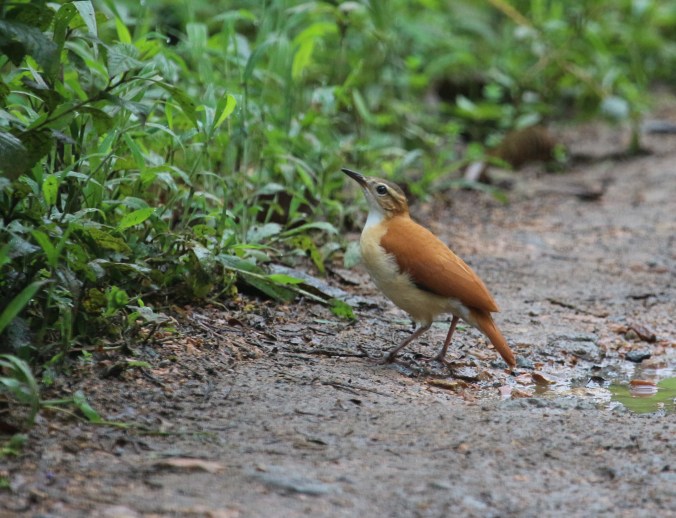
As the sky began to lighten, I looked outside the van’s windows at a landscape of endless tall, forest-covered mountains bathed in clouds.  We had been driving in the pre-dawn darkness up a bumpy, winding, gravel road into the mountains for the last half hour.  A large bird with an unusual upright posture hopped out into the road in front of our van, turning its chunky bill to look straight at us.  It had a chestnut colored head and its white breast was finely streaked with black.  A chestnut-crowned antpitta, we realized, one of the most easily seen of the notoriously shy and difficult to see antpitta family, but still a very nice bird.

The Bellavista Lodge had put out moth traps the night before, and as the sun rose, birds came to feast on the torpid moths.  It started slowly in the gray light, with strong-billed and montane woodcreepers stalking up the trees, and russet-crowned warblers foraging in the bushes near the parking lot.  Soon, however, we were spotting new birds at such a rate that it was hard to keep up.  White-winged brushfinches, masked flowerpiercers, brown-capped vireos, white-tailed tyrannulets, golden-crowned flycatchers, smoke-colored pewees, plain-tailed wrens, and gray-breasted wood-wrens flew about, eating moths in a frenzied blur of activity.  Pairs of small, cute, reddish cinnamon flycatchers hunted from exposed twigs.
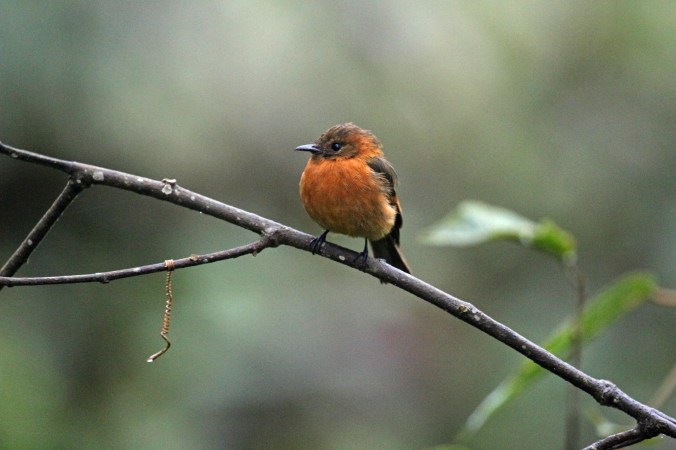
IMG_0564_edited-1.JPG

Cinnamon Flycatcher (Pyrrhomyias cinnamomeus)

Suddenly, a brilliant-blue bird flew down out of the canopy onto a banana feeder and materialized into a turquoise jay, one of the most stunning birds I have ever seen.  The jay was soon joined by a group of toucan barbets, ridiculously colorful birds with black crowns, white ear tufts, slate gray throats, red breasts, yellow bellies, and olive-green wings.  I spotted a male masked trogon sitting on a light post on the lodge, but I was distracted from photographing it by a powerful woodpecker flying onto a tree trunk.  As the morning burst of activity finally began to die down with the sun fully up, we noticed an Azara’s spinetail hoping slowly through a tangle of dense brush near the ground, and a streaked tufted-cheek hopping on a stump.

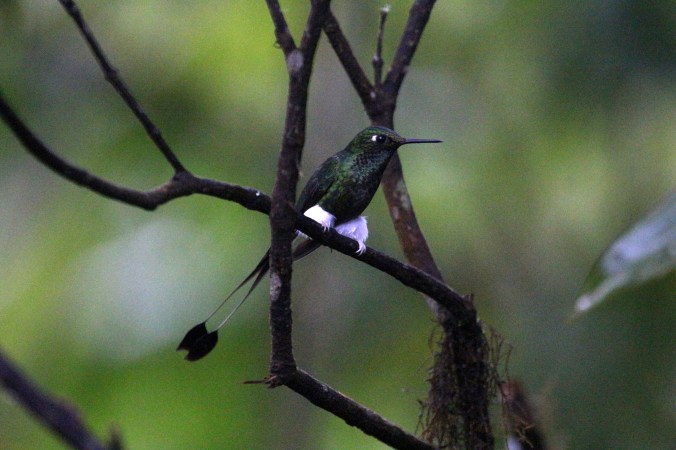
At Bellavista Lodge’s hummingbird feeders, we watched the tiny but energetic booted racket-tail vie for its position on the feeder with other much larger hummingbird species such as buff-tailed coronet, collared inca, and fawn-breasted and empress brilliants.
IMG_0499(1).jpg

A booted racket-tail watches other hummers drink at the feeder.

We walked back to our van for a breakfast of fruit, muffins and hard-boiled eggs before continuing our search.

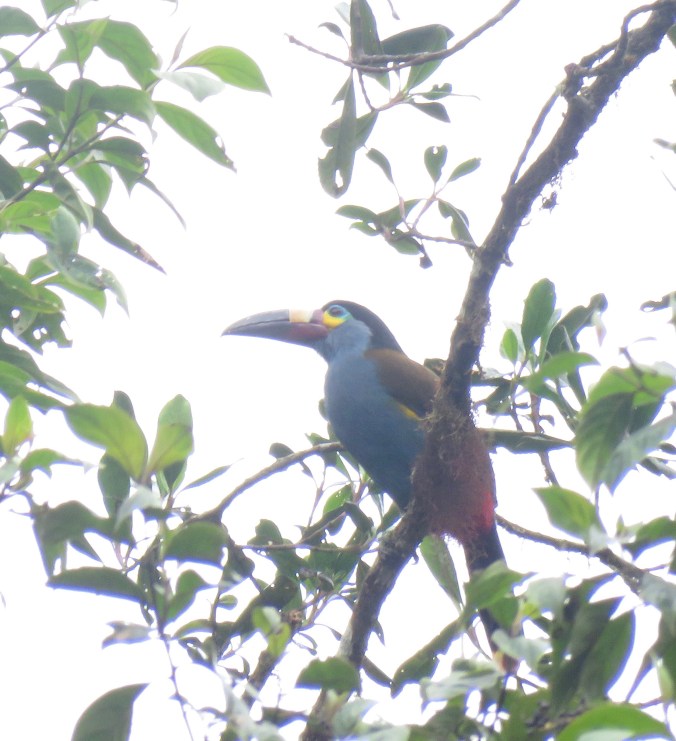
We walked up the long, winding entrance road that we had driven in on earlier that morning, looking and listening for birds.  A loud, carrying whistle came repeatedly from the dense brush near a small, rocky cascade of water off to our right.  We tried for some time to locate it, but eventually we had to give up, and be satisfied with our heard-only ocellated tapaculo.  We picked through flocks, finding endemics such as Choco brushfinch, and dusky chlorospingus, along with blackburnian, black-and-white, and russet-crowned warblers.  We began to hear a repeated, faint screeching noise rising out of the valley below us, but I paid little attention to it until a large chunky bird with a humungous bill flew into a tree across the road from us.  The plate-billed mountain-toucan’s face was very striking, with a large blue, red, and yellow bill, and yellow and blue facial skin above its eye.  Plate-billed mountain toucans live only in the mountains of north-west Ecuador and the very south-western province of Columbia.  They are listed as near-threatened, their primary conservation concerns being habitat loss from deforestation, and illegal capture for the pet trade.
IMG_5258.jpg

Plate-billed Mountain-toucan (Andigena laminirostris), Photo by Theo Staengl

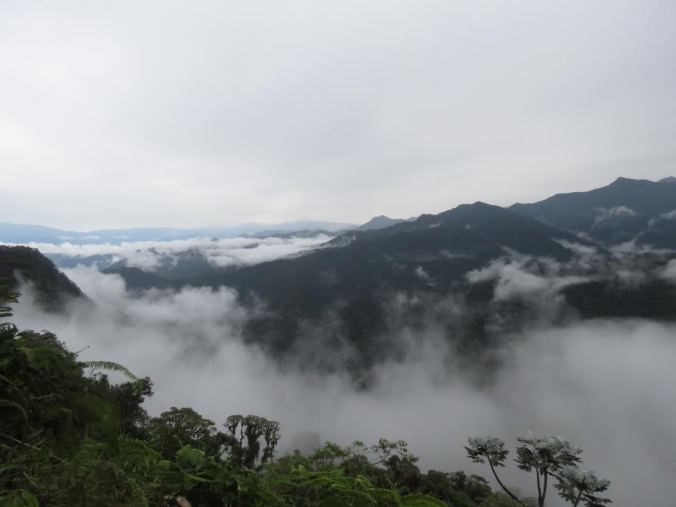
Soon after the toucan flew off, we turned off the main road onto a small dirt trail that followed the top of a ridge to an overlook.  The loud trill of a Spillmann’s tapaculo sounded from a clump of roots.  We emerged from the trees, into the diffused light of an overcast day.  Mountains stretched into the distance as far as we could see, their tops shrouded in mist.
unnamed.jpg

Bellavista Cloudforest, Photo by Theo Staengl

Reluctantly, we left the beautiful scenery and got back into the van for the bumpy ride to our next stop.

At the Quinde Luna Cloudforest Reserve, we sat on a patio looking out toward five or six hummingbird feeders.  More than fifty hummingbirds of thirteen different species swarmed around us at barely comprehensible speeds, living their lives at an insane pace.  In the span of seconds, two hummingbirds would go from drinking peaceably next to each other on a feeder to intense, high speed, aerial combat, finally falling, shrieking and chattering to the ground.  I couldn’t help wondering how they avoided collisions at such speeds, and despite their obvious ability to navigate, I felt an irrational impulse to cover my eyes whenever they came whirring by.  The hummingbirds’ array of colors and shapes mesmerized and entertained me long past the point where we had identified and photographed all the species present.  Seemingly every part of the hummingbirds was colorful and unique, from their bills and tails to their body plumage and fantastically iridescent gorgets.  The booted racket-tail has two big clumps of white feathers over its legs, which look like little furry white boots.  The violet-tailed sylph has a long, dazzling iridescent blue tail and a stunning greenish crown stripe.  Velvet-purple coronets are a rich, flashy purple color, with black highlights.

IMG_0787_edited-1.JPG

Violet-tailed Sylph (Aglaiocercus coelestis)

Almost all the thirteen hummingbird species were new for me, and many of them were Choco region endemics as well.  We walked around the hummingbird garden between the feeders, watching the hummingbirds go about their frantic business.  One of my favorite endemic species, the purple-bibbed white-tip perched on a branch right in front of me.

IMG_0871.JPG

Purple-bibbed Whitetip (Urosticte benjamini)
Birding Mindo

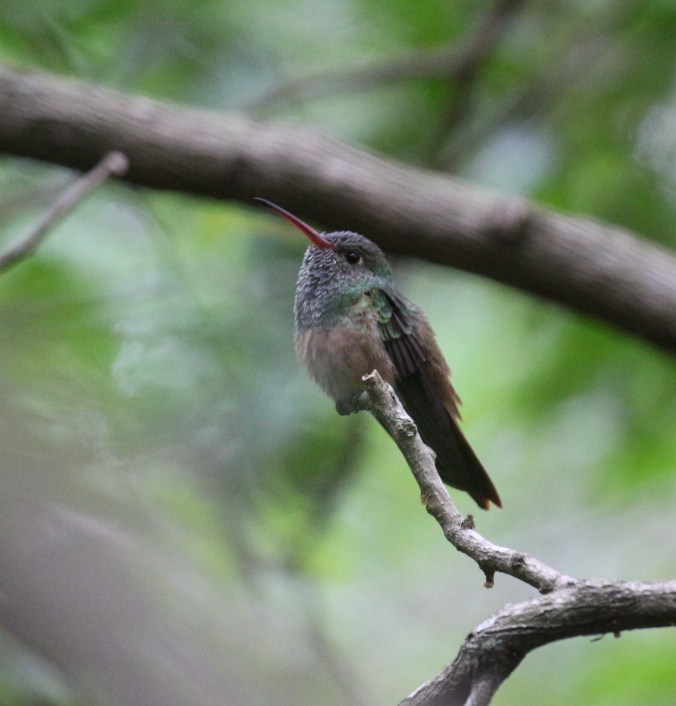
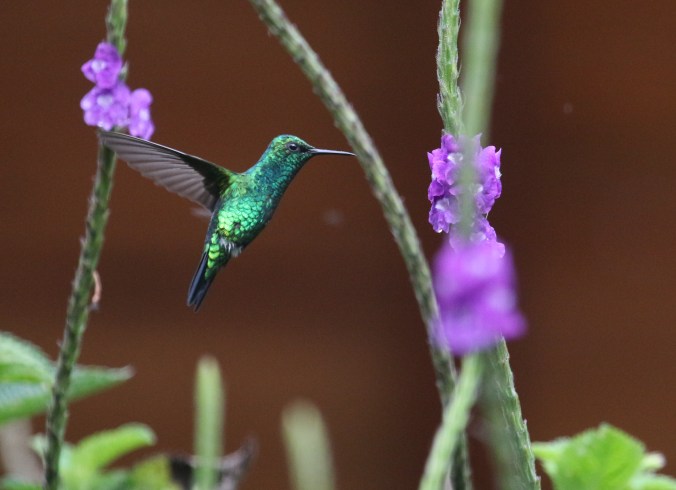
I woke at 6:00 AM on my first day in Mindo, Ecuador to the sound of hundreds of unfamiliar birds chattering and singing.  My brother Theo and I got out of bed, and together we walked out onto our deck, peering through the half light at the backlit forms of singing birds.  The large elegant shape of a motmot caught our eyes sitting in a fruit laden tree in front of us, but it was still too dark to make out enough color to identify it.  As the sky lightened, we began to notice tanagers foraging in the flowers of the same tree.  We identified flame-rumped, blue necked, bay-headed, and golden tanagers, which were all lifers.  I noticed a tiny, richly patterned hummingbird, reminiscent of a bumblebee, buzzing on some purple flowers and I called Theo’s attention to it.  We later learned that it was a purple-throated woodstar. Other common hummingbirds that we saw that first day included rufous-tailed hummingbirds, western emeralds, and the green crowned brilliant.

IMG_0241_edited-1.JPG

Western Emerald (Chlorostilbon melanorhynchus)

After breakfast, we decided to bird the popular waterfall trail, a road leading up into the mountains above the town of Mindo.  We had heard that white-capped dippers and torrent ducks could be seen in the white-water and waterfalls accessed along the road.  Fifty foot tall dirt banks loomed over us as we walked up the road, their sides adorned with lush, dripping vegetation.  Mosses carpeted everything, from the huge trees and tree ferns to the occasional well lit patch of forest floor.  The forest was so dense it was hard to see beyond a few feet from the road.  As the road climbed onto ridges, we were able to look down at the canopy on either side of us. Here we encountered our first large tropical foraging flock.  We came around a bend, and suddenly birds were everywhere — tanagers of all descriptions, wood-creepers, spinetails, flycatchers, and warblers.  Some warblers familiar from home like blackburnian and Canada warblers, and tropical parulas, were joined by new species like slate-throated red-starts and three-striped warblers.

After several more exciting flocks, we turned off the road onto a small dirt trail that descended swiftly down into a heavily wooded valley.  The trail was slippery and muddy, cut into a steep cliff with metal railings on one side.  A small flock exploded in the trees over our heads.  The brilliant, golden orange faces of flame-faced tanagers stood out in the dark leaves.  Soon we saw our first white-winged tanagers and blue-winged mountain-tanagers of the trip.  As we descended into the valley, the air grew noticeably warmer and more humid.  An agouti, a large, rabbit-like rodent, ran across the path in front of us as we entered a clearing.

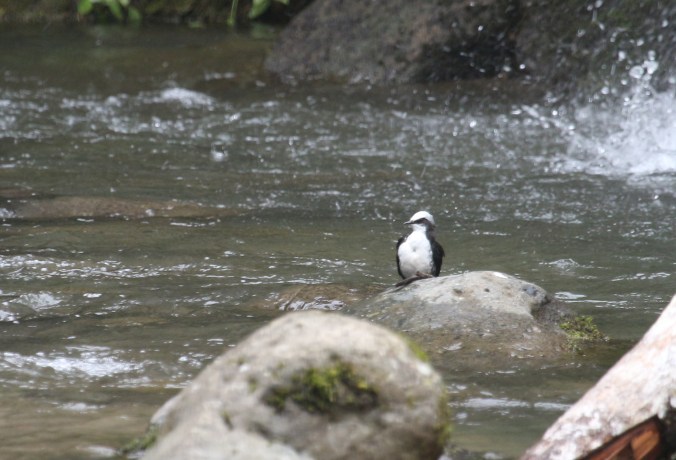
We crossed a rickety metal bridge with rotting bamboo hand-rails at the first river crossing.  The water churned beneath us, rushing over rocks in white clouds and crashing back into the river-bed.  Despite the rough water, we could not see a dipper. We came to a place where cement had been lain on the banks of the river, changing and channeling the water into a deeper slower spot.  An incredibly steep-looking water slide made of crumbling cement was positioned on one of the nearly vertical banks of the river.  We continued until the trail ended just past another river crossing, and turned around.  As we began climbing the slope away from the river, I looked back and saw a white blob on one of the rocks in the turbulent stream below. I raised my binoculars, and saw it was a white dipper with a black mask. We had found a white-capped dipper after all.

IMG_0362_edited-1.JPG

White-capped Dipper (Cinclus leucocephalus)

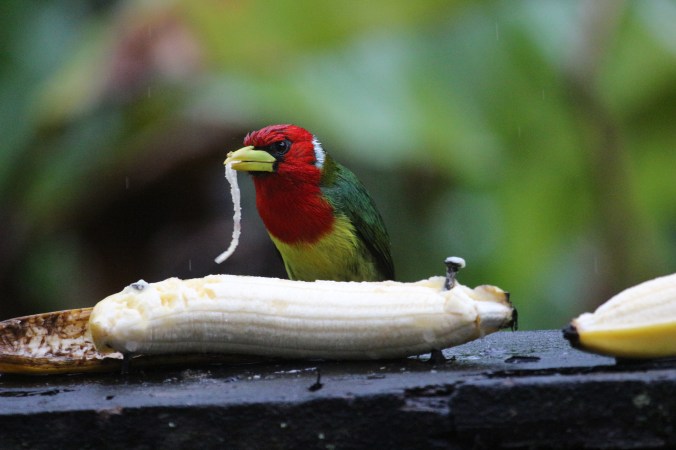
During our visit to Mindo, we had many opportunities to bird the grounds of Las Terrazas de Dana Lodge, where we were staying.  We found that in the early mornings and late afternoons the birding was often good in the trees around the edges of the cabins, with larger and more frequent tanager flocks there.  All the common tanagers, thick-billed euphonias, yellow-tailed orioles, green-crowned brilliants, and red-headed barbets also fed at the lodge’s banana and hummingbird feeders in the late afternoon.  When we tasted the Ecuadorian bananas, it became apparent why the birds appreciated them so much.  They were the sweetest, creamiest bananas I’ve ever had, and they were never hard and green or brown and rotting.  We asked the lodge for some to put on the platform banana feeder directly behind our cabin, and we soon had all the brilliantly colored tanagers and barbets visible from our private deck.

IMG_0875.JPG

Red-headed Barbet (Eubucco bourcierii)
On several occasions we walked out of the entrance of the lodge and went right on the road, away from the town of Mindo, and the turnoff for the waterfall trail.  We twice encountered a scarlet-backed woodpecker on this road, as well as an olivaceous piculet, which is an exciting little tropical mini-woodpecker of sorts. Southern lapwings flew about in the field across the road from the lodge, and roadside hawks were also often present.  One day we made the trip down this road while it was raining, and we lucked upon a torrent tyrannulet hunting over a little trickle.  We also saw a striated heron, variable and yellow-bellied seedeaters, and a cooperative pale-legged horneo.

IMG_1551_edited-1.JPG

Pale-legged Horneo (Furnarius leucopus)

Another location in Mindo that we birded multiple times was the Yellow House Trails, a 494 acre reserve of secondary and primary cloud forest.  From the Yellow House Lodge at the beginning of the trail, we climbed up over cow pastures and scattered guava trees towards the top of the mountain, where the forest started.  From the exposed vantage point the slope gave us, we could look out on raptors flying in the valley below.  We saw roadside hawks, hook-billed kites, and even a rare snail kite.  Once we reached the rainforest, smaller trails numbered one through five branched off the main trail.  These trails wound right through the heart of the cloud forest, giving a close up view of it.  Huge trees towered over a dense understory of bushes and vines, which were carpeted in mosses and epiphytes.  The forest was so dense that it was often hard to see far enough to spot birds, but despite this challenge, the trails were still very productive.  Pale-mandibilled aracaris and yellow-throated toucans squawked and flew about in the canopy.  On the way back towards Mindo via the main trail, we saw a crested guan slowly walking about in the top of a tree.

In the first mixed flock we encountered on the Yellow House trails, we spotted a cerulean warbler, a beautiful and endangered songbird that breeds in the Appalachian Mountains of the eastern United States.  Seeing one so far from where I’ve experienced them in the summer in Virginia highlighted for me the importance of such far flung places as habitat, even for a songbird as representative of the southern Appalachians as the cerulean.  It also helped to complete my picture of the species, adding a memory of it foraging in the cloud forest canopy with species like fawn-breasted, golden and blue necked tanagers to visions of cool early spring mornings when the buds are just opening and the trees are full of bird song back home.

Mindo is located in the Choco-Darien moist forest ecoregion, a biodiversity and endemism hotspot that ranges from southern Panama through north-western Ecuador.  Almost 70 species of birds that live no where else in the world can be found in Mindo and the surrounding mountains.  When I first became interested in going to South America a couple of years ago, I wasn’t sure whether I would rather travel to Peru or Ecuador.  In the end, Mindo’s incredible birding and ease of access – its only 2 hours from Quito international airport by car – won the case for us.  After more than a week in the Mindo area, I definitely felt that we made a good choice.  If you have any questions about Mindo or the region, or information to share, feel free to email me or leave a comment.

Birding Coastal Virginia: Fleeing from the Snowstorm

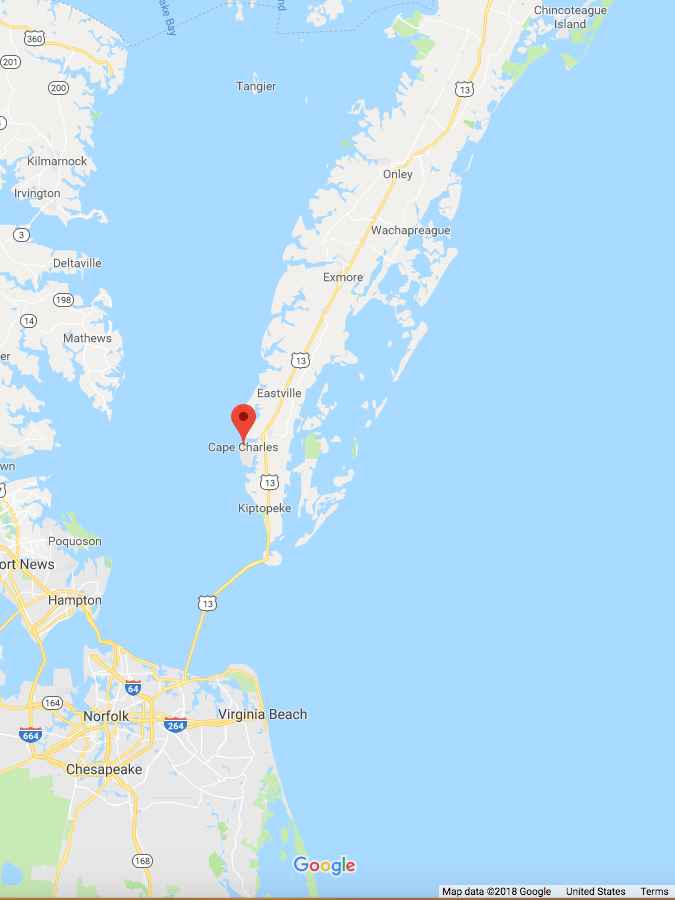
Four homeschooling birder friends, my brother and I woke up at the crack of dawn on January third in Virginia Beach, having driven in late the day before.  Over our hotel breakfast we learned that up to eight inches of snow was forecasted to start around 7 PM, centering around the Cape Charles area, with only about two inches in Virginia Beach and Chincoteague.  Our plan had been to bird Virginia Beach that day and then head over the bridge into Northampton County the next day, but now the snow might make it impossible to get there.  We decided to skip VA Beach and bird Northampton County immediately instead, and spend the night in Chincoteague, so if we got stuck, at least we could walk into the National Wildlife Refuge there.

Screen Shot 2018-01-12 at 9.54.13 AM.png

Map of coastal VA.   The marker is Cape Charles.

It was just getting light as we drove across the 23 mile long Chesapeake Bay Bridge Tunnel (CBBT).  We spotted large rafts of surf and black scoters from our car, as well as two year birds, great cormorant and peregrine falcon.  Soon after crossing the CBBT, we came to Magothy Bay Natural Area Preserve, our first stop.  The leaves of the wax myrtles and grasses were frozen, with tiny ice shards coating them, creating a silvery glitter wherever I looked.  Yellow-rumped warblers flitted about everywhere, no doubt trying desperately to eat enough myrtle berries to keep them alive in the frigid weather.  As we turned a sharp corner in the path, an American woodcock exploded out of the brush by our feet, its wings whistling.  The trail continued into an old pine woodland, where we heard brown-headed nuthatches, before opening into expansive salt marshes lining Jones Cove.  We worked our way along the edge of the water, listening for salt marsh or Nelson’s sparrows and scanning all the waterfowl we could find.  I got on a flying female common goldeneye, but I couldn’t get anyone else on it before it disappeared.  A flock of fifteen common mergansers flew over us, more than double the previous county high-count for the species.  As we continued our search for sparrows other than swamp or song, a cacophony of geese honking filled the air, and nearly five-hundred Canada geese descended from the sky.  Mixed in with the geese were a few duck flocks, with northern pintail and American black duck.  Despite continued searching, the only marsh birds we could find were a sedge wren and an orange-crowned warbler.

Our next location was Cheriton Landfill, the site of Virginia’s first state record of Lucy’s warbler, which we saw last year.  Fifteen hundred Canada geese swam in the little pond next to the landfill, but there wasn’t one single rare goose among them.  Mixed in with the geese, however, were twelve species of ducks, including redhead, green-winged teal, American wigeon, and northern shoveler.  We walked down the road behind the landfill, seeing song and savannah sparrows, but not much else.  As we walked back toward the car, over fifty black vultures circled above our heads, catching the morning thermals.

As we were driving to the Cape Charles harbor, we got an update on the weather.  They were now calling for over a foot of snow, and up to eight inches in Chincoteague.  We also learned that our hotel in Chincoteague did not have a generator.  With much regret we decided it would be better to abandon the coast at the end of the day, and spend the rest of our trip in Northern Virginia.

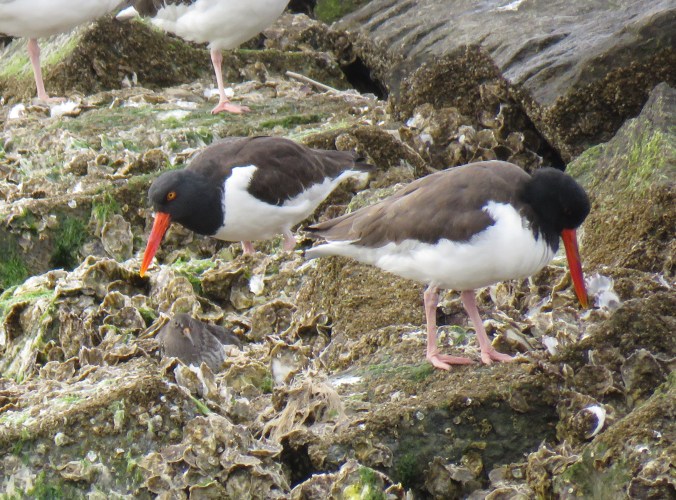
As we walked through the dunes to the harbor, two pale white sparrows flew up onto a sign.  We quickly saw they were “Ipswitch” savannah sparrows, a range restricted coastal subspecies that was new for most of us.  Forty American oystercatchers rested on a long rock jetty projecting in to Cape Charles harbor, and purple sandpipers, ruddy turnstones, and sanderling fed around their feet.

IMG_2181_edited-1.JPG

American oystercatchers and purple sandpiper.  Photo credit: Theo Staengl

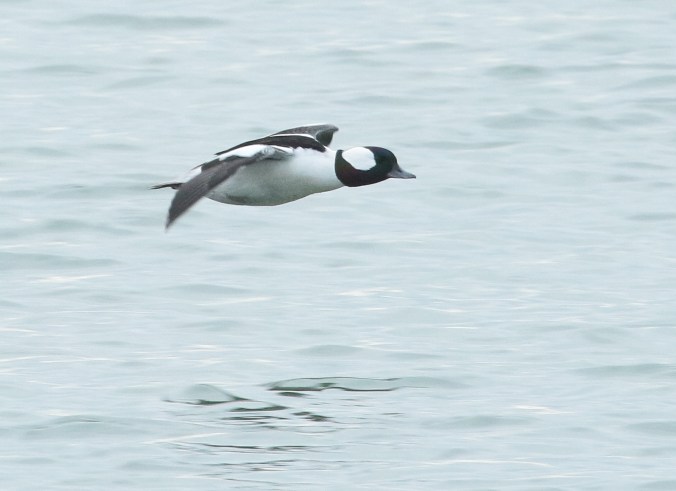
We watched bufflehead, surf scoters, greater scaup, and ruddy ducks fly around, and practiced getting flight shots of them.

IMG_9456_edited-1.JPG

Bufflehead flight shot

As we were leaving, two flocks totaling 13 common mergansers flew over us, leaving us to wonder why there were so many of them in Northampton that day when they are usually fairly rare.

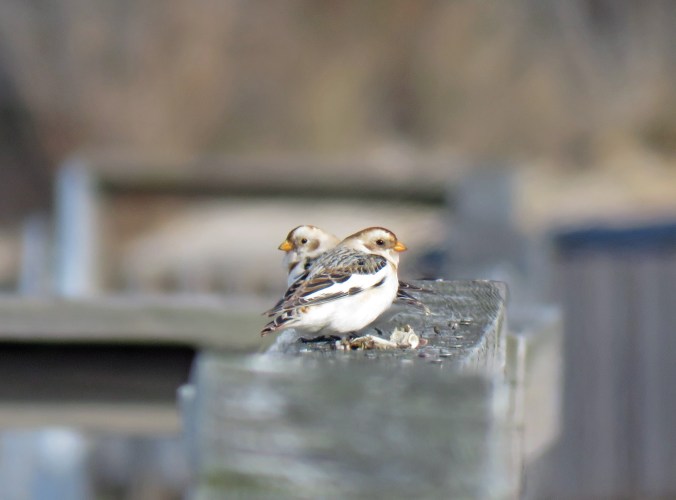
Our final coastal location before we had to head inland was the Kiptopeke State Park Fishing Pier, where two snow buntings had been hanging out.  The fishing pier is a rather dreary place, a large artificial projection into the bay with an inch of dead yellow grass on top.  From it, you can see a chain of ancient naval vessels out on the water, stripped of any useful material and left to rot.  Finding the white snow buntings in a flock of savannah sparrows and yellow-rumped warblers was not hard, and we observed these cute birds for a long time.

IMG_2330_edited-1.JPG

Snow Buntings (Plectrophenax nivalis) Photo by: Theo Staengl

Snow buntings breed in the high arctic tundra, and according to wikipedia have the farthest north distribution of any passerine.  In the winter they migrate down into boreal Canada and New England, and a few overshoot and end up in places like Virginia.

We were disappointed that we wouldn’t be going to Chincoteague, but our coastal birding had still been productive, and with any luck birding Northern Virginia would be too.

Blue Ridge Young Birders Winter Field Trip to Northern Virginia

We stood shivering in the 22 degree early morning air, looking out on the partly frozen Potomac River.  To our left, we could see the smokestacks and apartment buildings of the District of Columbia, while across the river to our right the thick forests of Maryland loomed.  A thin coating of snow lay on the ground, extending out onto the ice of the Potomac.  Far out on the unfrozen parts of the river, a few-hundred ducks huddled, periodically diving or dabbling.  Occasionally, a group of common mergansers flew overhead, their green or brown heads contrasting sharply with their white necks and bodies.  A sleek, camouflage covered boat drifted out onto the river, carrying two duck hunters towards the distant rafts of ducks.  Stirred to action despite the cold by the fear that the hunters would scare the ducks out of sight, we resumed scanning through our scopes.  Two lesser scaup and a few ruddy ducks dove up and down near the sides of a large group of over fifty canvasbacks.  Mallards made up most of the second, larger raft, with other dabbling ducks like American black duck and gadwall mixed in.  Behind these ducks, on the very horizon of what we could see clearly, more diving ducks drifted and dove.  Logan said that he had a long-tailed duck, one of the rare species we were looking for here, in his scope.  I looked in his scope and saw it, but before anyone else in our group had the chance, a gunshot sounded out on the river and all the diving ducks lifted off and flew far across the river into Maryland.

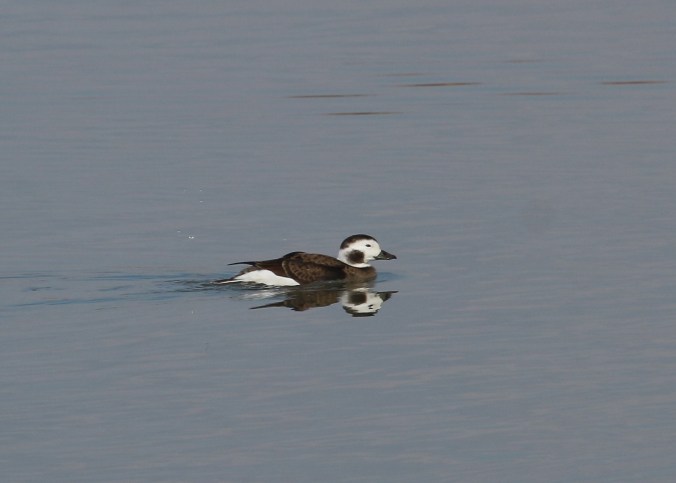
We walked down the road to the Dyke Marsh Wildlife Preserve, where we hoped to see more ducks and other birds.  To our left stretched acres of the last freshwater tidal marshes next to the Potomac, and to our right grew a beautiful mature swamp forest.  As we walked in, the thickets and clumps of vegetation along the path were hopping with song, white-throated, and fox sparrows.  Swamp sparrows flitted and chipped in the marshes.  The path eventually emerged out of the woods and onto a little peninsula that stuck out into the river.  We saw many more ducks from here, mostly diving ducks such as lesser scaup, ring-necked duck, canvasback, redhead, and common mergansers, and of course, the ever present mallard.  Baxter, Shea, and my brother Theo decided to walk across the peninsula on a boardwalk to check the other part of the river.  They soon called that they had a long-tailed duck.  The rest of us rushed over the boardwalk, heedless of the slippery snow that coated it.  There turned out to be two female long-tailed ducks, quietly swimming about on the other side of a small cove, barely ten yards away.

IMG_8935_edited-1.JPG

Long-tailed Ducks (Clangula hyemalis) are typically a coastal species during the winter, so seeing one inland on the Potomac River is certainly note-worthy.

The diffuse winter morning sun lit the ducks from behind us, creating a gorgeous medley of rich colors.  One of the ducks seemed to have a belly itch, because it kept turning upside down in the water and preening its belly in a rather comical fashion.  It would sit upright in the water, and use its feet to keep it from falling over, making it swim backwards in a vertical position.  Here is a video Theo got of this preening behavior.


On our walk out of Dyke Marsh, we counted 10 fox sparrows, which is the most I have ever seen at once.

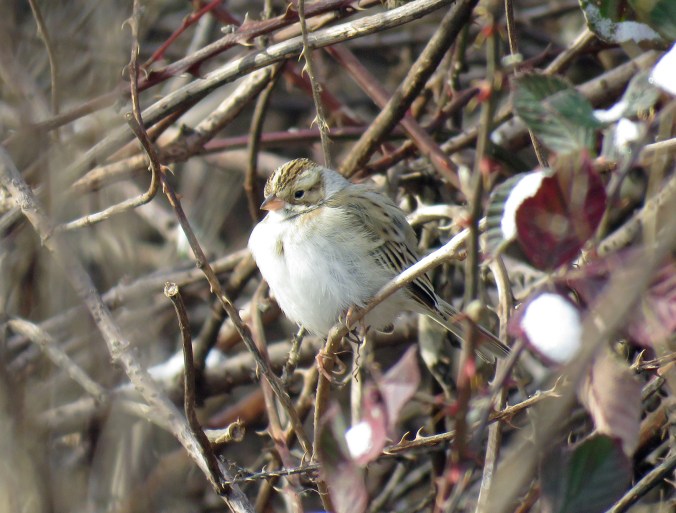
Our next stop was the Laurel Hill Equestrian Area, to look for a clay-colored sparrow.  We followed the directions we had been given from the parking lot back down the road, past huge clumps and tangles of blackberry vines and grasses.  Soon we came to one such tangle, which happened to be the one the clay-colored sparrow favored.  As we walked around it, we saw a flock of white-crowned sparrows foraging next to the road.  The clay-colored sparrow was immediately apparent, as it was about half the size of the white-crowned sparrows.  Whenever the clay-colored sparrow got too close to a larger white-crowned sparrow, there would be a brief scuffle, followed by a flurry of snow, and the clay-colored sparrow would have to move further off.  Despite its low status in the flock, it behaved fairly well for us, and we all got great looks and photos.

IMG_1575_edited-1.JPG

Clay-colored Sparrow (Spizella pallida), Photo by Theo Staengl

After a quick lunch, we headed over to Pohick Bay Regional Park, another place on the Potomac, where a Eurasian wigeon had recently been seen.  We walked out onto the river on a snow coated boat dock, set down our scopes, and began to scan.  Hundreds of gadwall formed the majority of the duck flock, with good numbers of American wigeon mixed in.  A humongous American coot flock swam a little bit further out.  Two horned grebes hunted behind the ducks.  We soon identified the Eurasian wigeon by its red head, and we all had descent scope views.

After a brief and uneventful stop at Occoquan Bay NWR, we drove to the Dulles International Airports parking garages, where we wanted to look for a continuing snowy owl and two rough-legged hawks.  From the top of the parking garage, we had an uninterrupted 360 degree view of the airport’s runways, but unfortunately this meant that there was no where to hide from the relentless wind.  Northern harriers and many short-eared owls hunted over the fields in the waning light.  Max soon found the snowy owl in his scope, perched on top of a distant airport terminal.  The 2017-2018 winter is shaping up to be a large snowy owl irruption, with birds already found in Franklin, Rockingham, Isle of Wight, Suffolk, King William, Accomack, and Loudon Counties this year.  It is very exciting to see these majestic northern owls so far from their home, using large farm fields and even airports as hunting grounds.  We stayed until the increasing darkness and the cold wind finally pushed us out, but despite seeing many red-tailed hawks, we could not find the rough-leggeds.  We got in the cars and started the long drive back to Charlottesville.


Birding the Upper Rio Grande Valley

We drove into the parking lot of the Harlingen Convention Center at 4:30 AM.  The huge fifty plus person bus that would take take us west along the Rio Grande Valley into Starr County idled at the curb.  We grabbed the lunches the Rio Grande Valley Birding Festival (RGVBF) had prepared for us, and hurried to join our friends on the bus.  We were very excited about this festival field trip to the “Upper Rio Grande Valley” because that area hosts some rare specialties that can’t be found closer to Harlingen.  Particularly, we were hoping to see white-collared seedeaters, red-billed pigeon, and wild muscovy ducks.  Despite these birds being very rare and local Rio Grande specialties, we figured we would get at least one.  In addition, Starr County has large stretches of desert, which host an assortment of southwestern desert species, such as greater roadrunner, black-chinned sparrow, cactus wren, and pyrrhuloxia.

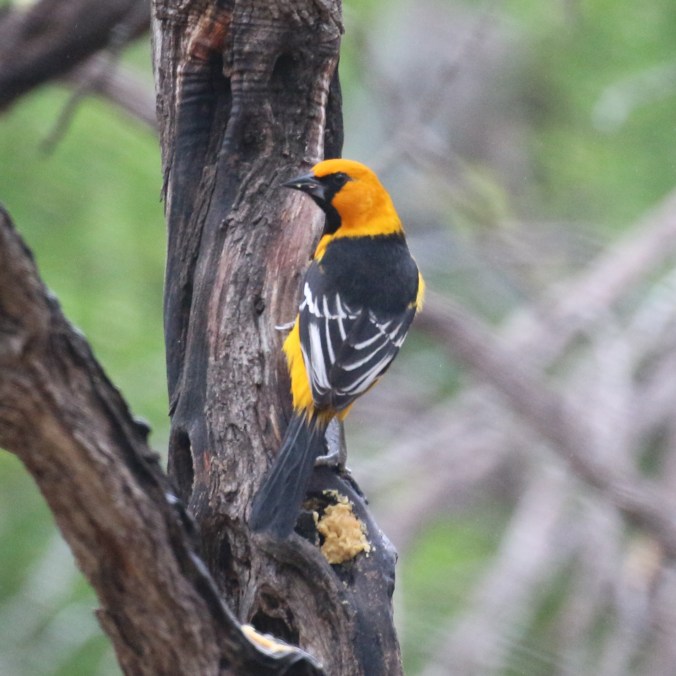
The overcast sky began to brighten as we neared our first birding location, a preserve along the Rio Grande called Salineño.  We walked down an old, cracked road, through thick, green vegetation.  The cool morning mists drifted off the ground, obscuring the old buildings and trees that lined the road.  Our guides told us that we would have to split up into groups to seek the seedeater, because too many of us would scare it.  As another group branched off, we continued down toward the river to watch for red-billed pigeons.  We came to a small boat launch, where we set up our scopes and waited.  Mist rose off the muddy waters of the Rio Grande in front of us.  Audubon’s and altamira orioles called from the feeding station behind us.

IMG_7889.JPG

Altamira Oriole (Icterus gularis)

Green jays constantly flew over the river in front of us.  Double-crested and neotropic cormorants flew overhead.  We saw northern pintail, gadwall, blue-winged teal, lesser scaup, and the “Mexican” subspecies of the mallard on the river.  We waited patiently for the seedeater group to come back, without seeing a pigeon.  When the first person from their group wandered into view, we asked them if they’d seen the seedeater.  They nonchalantly replied that they had.  We asked our guide if our group could go and look for the seedeater.  He said he didn’t personally have much interest in it, but eventually led the way.  We walked up a trail over sandy bluffs overlooking the river, scanning the cane patches where our guide said the seedeaters liked to hang out.  As we worked our way upriver, we encountered a mixed flock, mostly blue-gray gnatcatchers and orange-crowned warblers, but we also found a Nashville warbler, a Bewick’s wren, and a verdin.  We stared down into the thick cane for hours, not daring to move for fear of scaring off the supposedly super timid seedeaters.  Every few minutes someone would raise their binoculars, and invariably they would mutter “common yellow-throat” as the bird slid back out of sight.  At noon our guide announced we had to return to Harlingen.

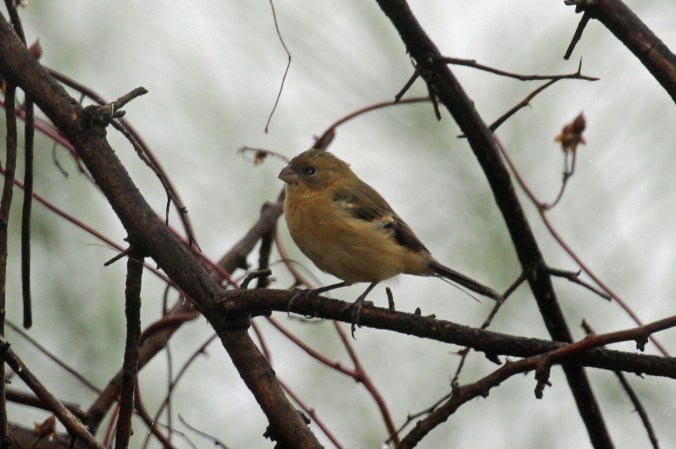
The next day, my friends and I decided to make the two hour drive back to Salineño one more time, in hopes of seeing the seedeater with a smaller group.  My friend Max also knew a place nearby where we could get scaled quail, and other desert birds that we had been hoping for on yesterday’s trip.  When we arrived at the boat launch, we were glad to find we were the only ones there.  We walked slowly up the path toward the cane stands, listening for unusual calls and watching for unaccounted movement.  As we stood staring intently at the largest patch of cane, my friend Ander said he thought he saw one.  We turned, and not twenty feet away, in a small mesquite bush, sat a tiny, cinnamon brown bird.  At long last, a white-collared seedeater!

IMG_8034_edited-1.jpg

White-collared Seedeaters (Sporophila torqueola) have become increasingly hard to find in Texas, despite being reasonably common as recently as the 1940s.

Just as we all got on the bird, it flew out of the bush, flashing it’s white wing-bars and small tail.  We followed the bird away from the river, into a small, rocky gully, where we suddenly heard a whistled down-slurred “chew” call from the trees above us.  Looking up, we saw the White-collared seedeater perched in another tree.  No wonder we hadn’t found them the day before by looking in the cane stands.  At the sound of another “chew,” we looked down to see a second bird hoping on the rocks.  We watched the two birds forage and chatter for a while, before they flew off across the river.  It was amazing how much easier they were to find without a huge group of people.

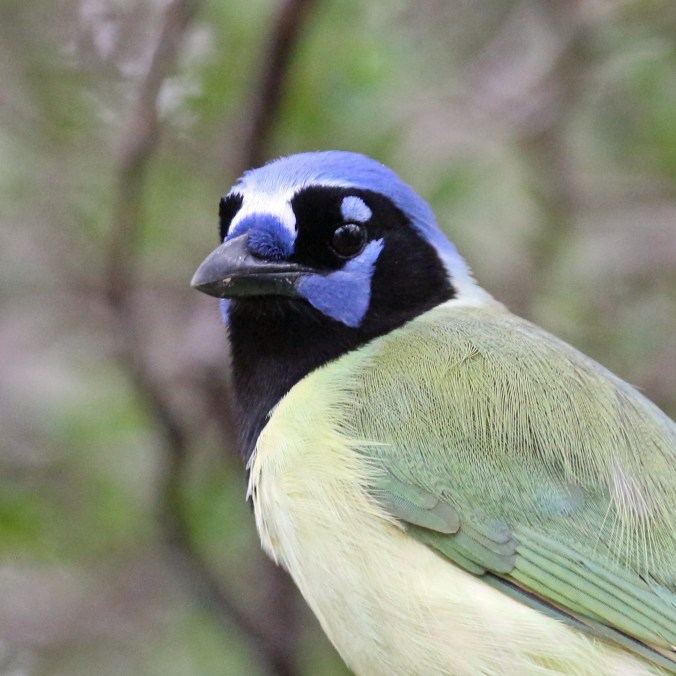
As we drove toward our next stop, a nursery specializing in the plants of the south Texas desert called Rancho Lomitas, the landscape became increasingly desolate and arid.  Huge cacti and thorny bushes grew next to the road.  Black-throated sparrows perched on emergent vegetation.  When we stepped out of the cars onto a soil of hard-packed sand, we were greeted by a man named Jim, who told us about the Ranch and showed us to chairs in front of his trailer that looked out on a well-stocked feeding station.  He told us that if we waited long enough, we should be able to see cactus wrens, pyrrhuloxias, and scaled quail right there.  As soon as we sat down, green jays began swooping in five feet in front of us.  The incredibly close proximity allowed me really appreciate their intricate and gorgeous blue, black, and green patterning.

IMG_8125_edited-1.JPG

Green Jay (Cyanocorax yncas)

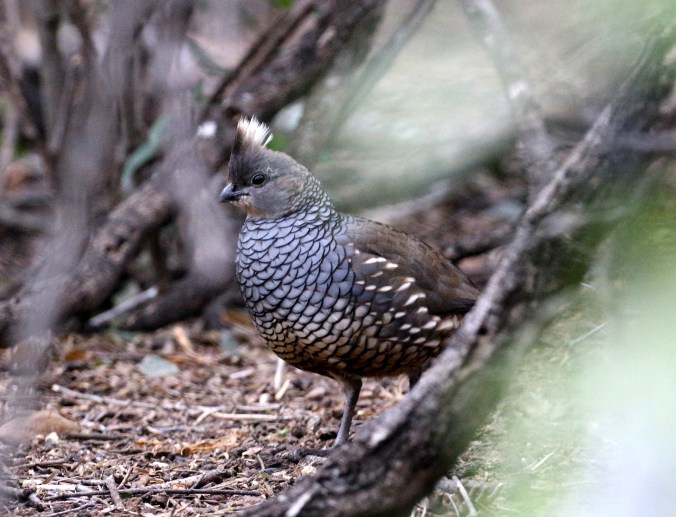
After about five minutes, a movement behind a large flower pot next to me caught my eye.  A cactus wren hopped out from behind the flower pot, and flew up to a platform hanging from a huge cactus, right in front of my face.  It was a life bird for many of my friends.  Suddenly, something moved in the dense brush behind the feeders.  Than a cute plumed face came out into view.  Before long, there were five scaled quail scratching on the ground right under the feeders.  When someone walked past, they would fly up into a tree above our heads, and slowly come back down.

IMG_8117_edited-1.JPG

Scaled Quail (Callipepla squamata)

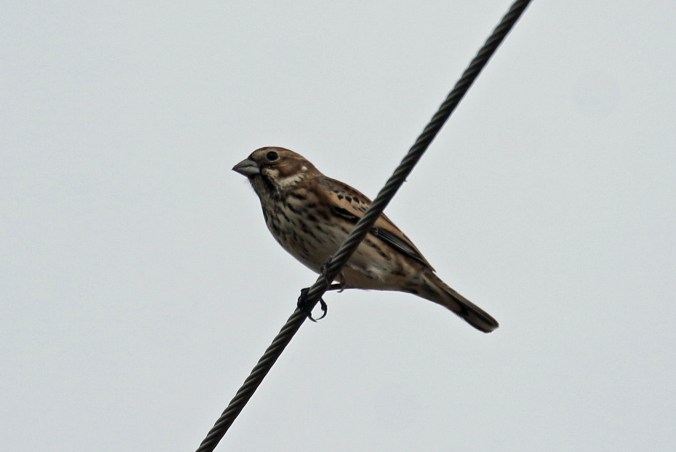
We watched the birds at the feeder for a while longer, and than decided to bird the nearby roads to see if we could find a pyrrhuloxia.  Sure enough, just on the other side of the clearing from Jim’s trailer, we found the desert cardinal perching in the top of a dense, thorny bush.  Pyrrhuloxias are mostly a waxy gray color, with a bright yellow bill and a red crest and face, and red flight feathers.  As we continued down the road, we heard a Bewick’s wren chattering in the grass.  As we paused to watch it, I saw another bird fly across the road.  As it flew, it flashed white edges of its tail.  When it landed, we saw it was a female lark bunting, a lifer that I had not expected on this trip.

IMG_8177_edited-1.JPG

Lark Bunting (Calamospiza melanocorys)

When the lark bunting finally disappeared back into the grass, we turned and saw a great horned owl perched on the power line farther down.  We approached as much as we could without bothering it, and photographed it.  What a great end to a great day of birding.

Birding Big Day in the Lower Rio Grande Valley

Thick mist rolled off the spiny limbs of unfamiliar tropical vegetation as strange calls pierced the stillness of the early morning.  We crossed over a small channel of water, watching for green kingfishers, and then walked into the woods on the other side.  Large oak branches draped in Spanish moss hung over the trail.

We were at the famous Santa Ana National Wildlife Refuge, located in the very southern tip of Texas.  Birding at Santa Ana and other locations in southern Texas had been a long awaited dream for me, and it felt unreal that it was finally happening. My friends and I were participating in the Rio Grande Valley Birding Festival (RGVBF), and had scheduled this day to be a “big day,” an attempt to see as many species as possible in 24 hours.  We had all agreed in advance that we would be extremely relaxed about the pace, as we wanted to have as much time as we wanted with each new species.

As we continued walking through the old, tropical woodland, we heard the calls of great kiskadees, plain chachalacas, long-billed thrashers, and golden-fronted woodpeckers.  Mourning, white-winged, and Inca doves foraged on the ground.  Up ahead the trail opened into a large, wet marsh, called Pintail Lake.  As we walked out on an elevated dike towards the water, we heard American pipits, and spotted a vermillion flycatcher and two tropical kingbirds perched on projecting sticks.  We set down our scopes and started scanning the many ducks on the water.  We quickly found 11 species, including black-bellied whistling duck, mottled duck, redhead, and the lakes namesake, the northern pintail.

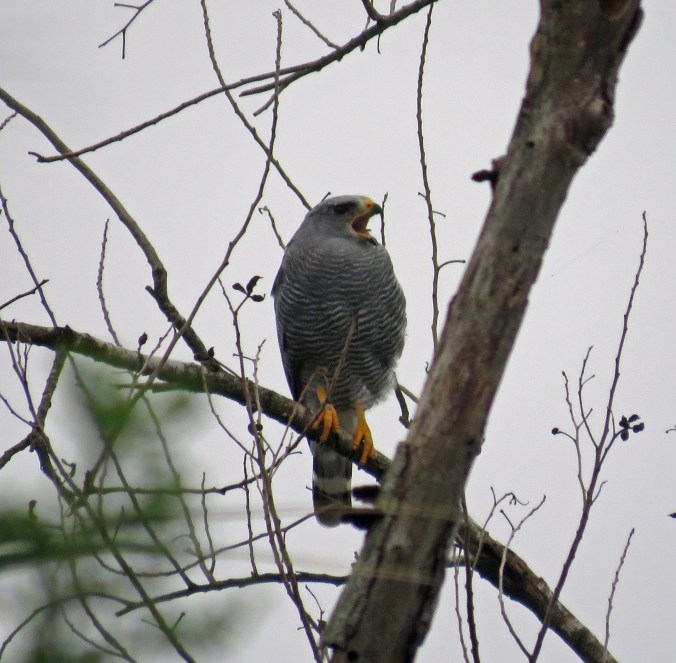
As we were about to get back into the cars, a small, gray Buteo flew low over the parking lot and landed in a nearby tree.  It was a gray hawk, a lifer for most of us.

IMG_7485_edited-1.JPG

Gray Hawk (Buteo plagiatus), photo by Theo Staengl

I had never been to our next stop, a small city park called Anzalduas, before, but I had heard it was a good place for zone-tailed hawk.  We drove there on roads on top of high dikes overlooking the Rio Grande.  Border Patrol vans were everywhere, but most just waved at us as we drove past.  When we finally got to Anzalduas, it wasn’t quite what I was expecting.  A far cry from most of the natural areas we were birding in the Rio Grande Valley, Anzalduas was a large expanse of sparse grass under periodically spaced trees, broken only by decrepit playground equipment.  The only other people around were twenty or so border patrol agents.

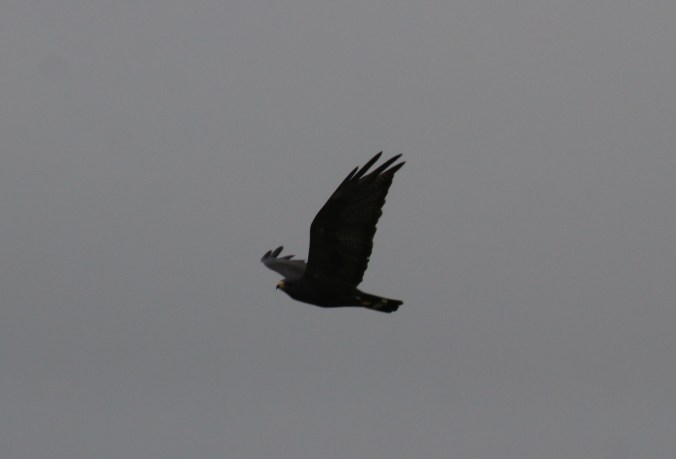
A local constable drove up and unpleasantly informed us that the road we had driven on into the park was closed to the public, despite the complete absence of signs saying so.  He warned he’d give us a citation next time.   We walked up a side road to another dike, across the park from the Rio Grande that was supposedly a very reliable spot for zone-tailed hawk, and possibly for hook-billed kite.  After several uneventful minutes, two things happened very quickly.  First, I noticed the constable’s car coming up the road toward us, and a large, thin-winged, mostly black raptor, a zone-tailed hawk, flew low over us.  We ignored the constable, and had beautiful looks at the hawk.

IMG_7697_edited-1.JPG

Zone-tailed Hawk (Buteo albonotatus)

When we looked down from the hawk, we saw the constable talking with my mom and our unofficial guide, who knew the local area well.  The constable pointed to two huge signs in front of the road we had just walked up, that said “no public use.”  We had honestly missed the signs because we had approached from the side, but from the constable’s perspective it sure looked sketchy.   In the end he let us go, and we hurried quickly off the dike.  The only other notable bird we saw at Anzalduas was a house finch, locally uncommon in the Rio Grande Valley.

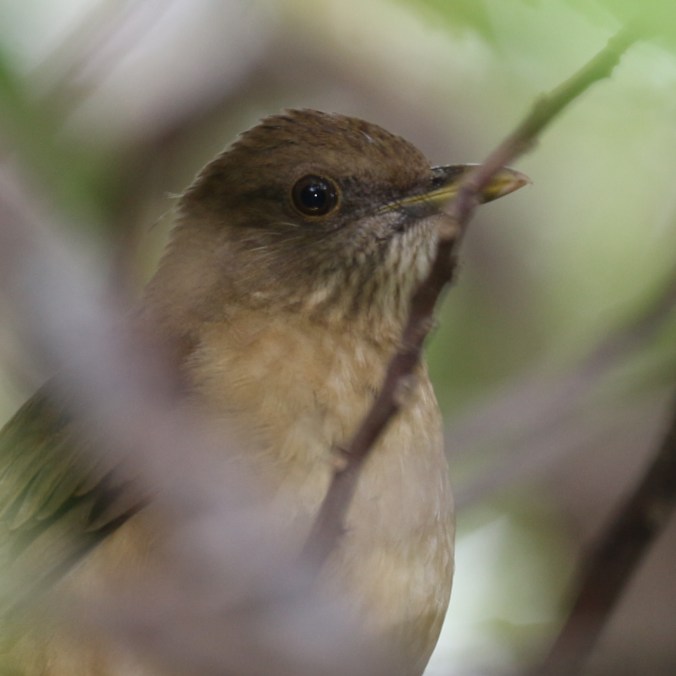
Forty minutes later, we pulled into the gravel parking lot of the Frontera Audubon Center’s small tropical reserve.  We walked the short, dirt trails through dense undergrowth, scanning the bushes around us for warblers and clay-colored thrushes.  As we neared a small feeder station near the visitor center, we found our first thrush flock, with about five clay-colored thrushes.

IMG_7736.JPG

The range of the clay-colored thrush (Turdus grayi) just barely extends into the United States in the very southern tip of Texas.  Clay-colored thrushes and many other predominantly central American species that just extend into the southern Rio Grande Valley are what makes south Texas such a birding hotspot.  These species are often referred to in the US as Rio Grande specialties, even though many of them are much more abundant further south.

We continued on the trails deeper into the woods, listening and looking for warbler activity.  That morning, someone had spotted a tropical parula there, which would be a life bird for all of us.  Soon we came to a wooden platform overlooking a small lake.  Warblers, mainly orange crowned, chipped and flitted in the dense willows.  We scanned the flock to the best of our ability, and were able to add Nashville, black-and-white, and black-throated green warblers to our day list.  We spent another hour roaming the trails looking for the tropical parula, but it proved to be a waste of time.  I was able to photograph a buff-bellied hummingbird, another fairly range restricted species, at one of the feeding stations, though.

IMG_7731_edited-1.JPG

Buff-bellied Hummingbird (Amazilia yucatanensis)

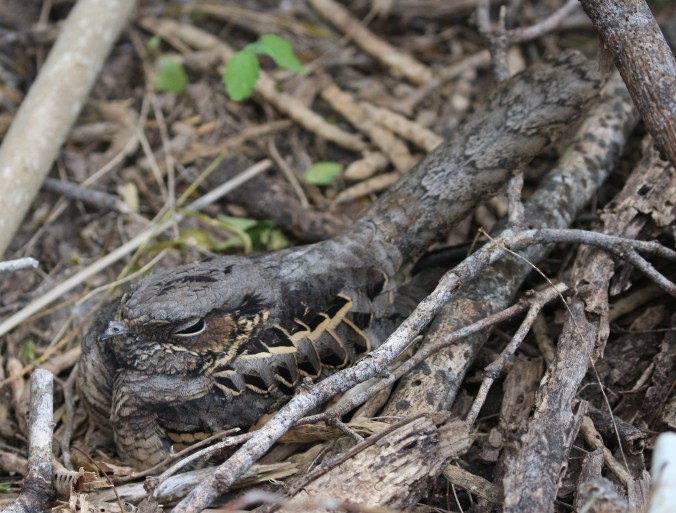
As we got out of the car at Estero Llano Grande State Park, I was beginning to feel worried we had spent too much time at Frontera, and we wouldn’t have enough day-light at South Padre Island, an important shorebird spot, later in the day.  Evan so, I couldn’t help enjoying the bountiful ducks at the visitor center lake at Estero.  Wild ducks swam peacefully about, clearly used to humans being nearby.  A vermillion flycatcher foraged from a dead stick over the marsh, its brilliant red belly and crown contrasting beautifully with its brown back and eye-line.  We added cinnamon teal and least grebe to our day list.  One of the birds I was personally most excited to see here was the common pauraque, a large tan nightjar of Central and South America.  While it is locally extremely common in south Texas, it is so cryptically patterned that one could easily walk within a foot without seeing it.  We were walking along a dusty dirt road near where pauraques have been known to roost when I almost stepped on one.  Once we noticed it, we were so focused on photographing it, we failed to see two others within a yard of it until some kind older birders pointed them out.  What a weird looking bird!

IMG_7818_edited-1.JPG

Common Pauraque (Nyctidromus albicollis)

We raced along the highway as the sky became cloudier and the sun sank ever lower toward the horizon.  Our rental car’s tinted windows probably did not help our feeling of impending darkness.  When we stepped out of the car at the mudflats above the South Padre Island Convention Center, wind coming off the Laguna Madre buffeted us and tore at our clothing and scopes.  We hurried over the muddy sand toward distant shorebird flocks, hoping the incoming tide wouldn’t strand us.  As soon as we could, we put down our scopes and started scanning.  We quickly found most of the common shorebirds we needed, along with two piping and snowy plovers.  It was only the second time I had ever seen a snowy plover, and it was a lifer for some of my friends.  We ran back to the cars across what were now inches of water, soaking our shoes.  We spent the rest of the daylight birding around the slightly more sheltered trails of the convention center.  Our list for the day was 126 species, the most I have ever seen in a day.


Fallout at Rockfish Gap

As we drove up the long, winding road to the Rockfish Gap hawk watch, the barely risen sun revealed a striking scene in the valley below us.  We looked down on a solid layer of dark, heavy clouds.  The gap of clear air that we were driving through quickly gave way to more clouds above us, obscuring the taller mountain peaks.

A light drizzle filled the cool air as we reached the parking lot of the Inn at Afton, where the hawk watch is located, and where our young birders club planned to meet for the day’s field trip.   Our plan today was to bird the Rockfish Valley Trail, a local hotspot in Nelson County, and than head back up into the mountains and bird the road known as State Route 610, or the Swannanoa road.  I was even more excited than usual as today’s trip would be the first time I served as trip leader.

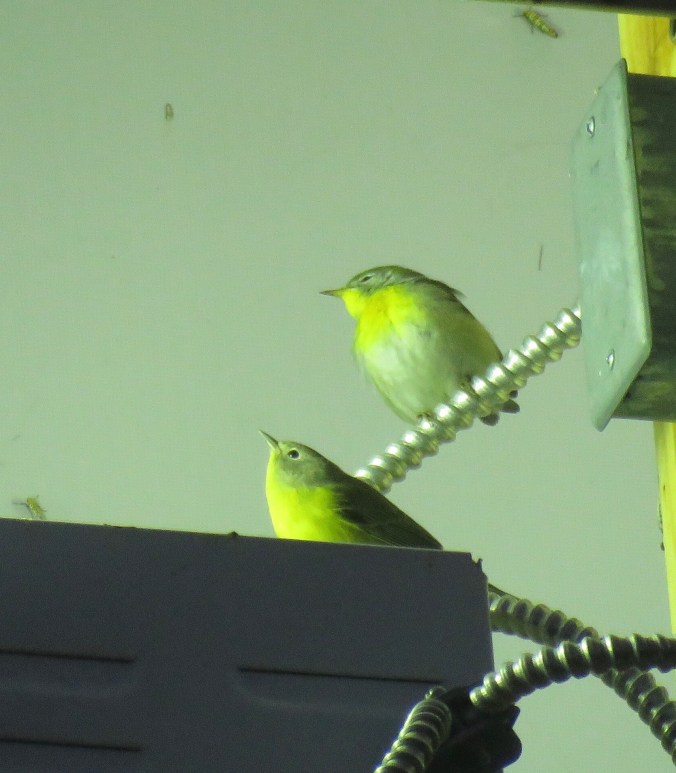
When I got out of the car, I heard the flight call of several warblers. Dylan, an eight year old who recently started birding with us, quickly joined my brother and me.  He pointed to a dilapidated, old road sign above our heads, and said he had seen birds in it.  The sign had once read “The Inn at Afton,” but the front had long since fallen off, revealing the sign’s bright interior lights, shining like a beacon to migrating birds.  When I raised my binoculars, I couldn’t believe what I was seeing.  More than 20 wood warblers sat on and near the sign’s lights.  Occasionally, another would drop out of the sky and join them, explaining the chips I had heard earlier.  Just than, the rest of the trip’s participants pulled up and joined us, making seven young birders total.

We found blackpoll, bay-breasted, black-throated blue, Tennessee, chestnut-sided, yellow-rumped, and black-throated green warblers, northern parulas, and common yellowthroats.  We even found a Nashville warbler in the sign.

35151888_Unknown.jpg

Nashville Warbler (Leiothlypis ruficapilla), with Northern Parula (Setophaga americana) inside the sign at the Inn at Afton.  Photo by Tucker Beamer.

We were excited by what this abundance could mean for the rest of our day.  If so many warblers were in such a small area, in such strange conditions, maybe today could be a fallout.  Fallout is a condition where due to sudden, severe weather, large numbers of birds migrating at night are forced down in a small area.  Fallouts are highly sought-after events for birders, as they can result in rare species and unusual numbers of birds.

As the sun rose, the light revealed a more gruesome scene.  Little bodies of black-throated blue warblers and common yellowthroats littered the parking lot, a sad reminder of the many dangers birds face on migration.  These birds were probably attracted to the bright light of the sign and the Inn, and met their death by flying headfirst into these obstructions.

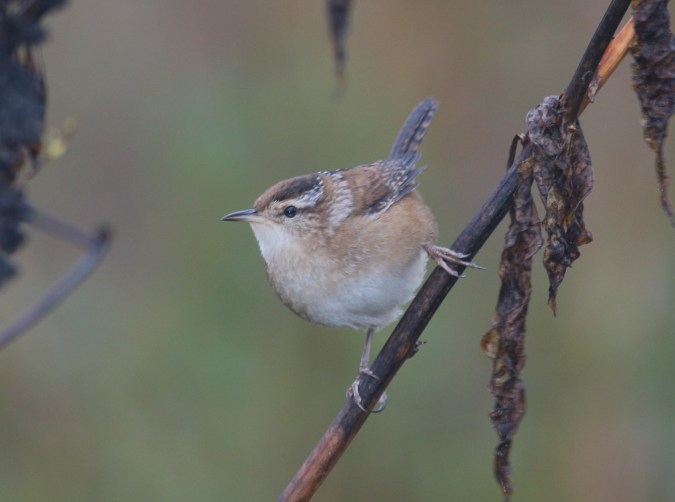
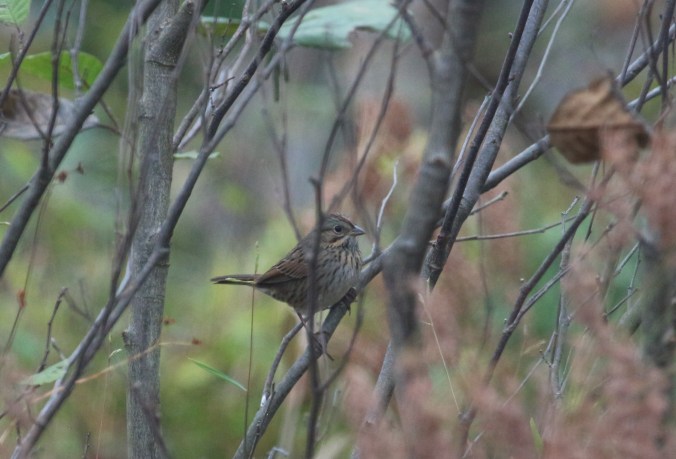
My brother and I had scouted the Rockfish Valley Trail the morning before the trip.  There had been sparrows everywhere, roving about the abandoned fields and brushy hedgerows in large flocks.  We had found five Lincoln’s sparrows, the first two white-crowned sparrows observed in Nelson that year, and tons of song and swamp sparrows.  As we scanned the flock, a strange chip suddenly came from the vegetation by our feet.  Looking down, I saw a blob of rufous feathers fly into another bush — a marsh wren!  Excitedly, we waited for it to make another appearance.  We soon found another one, and enjoyed fabulous views of both.

IMG_7065_edited-1.JPG

Marsh Wren (Cistothorus palustris)

It was the highest number of marsh wrens ever observed in Nelson County.  I hoped one would stick around for the next day’s field trip.

The thick cloud-cover had not thinned out much as we pulled into the parking lot at the Rockfish Valley Trail, a good sign for songbird activity.  We walked under Route 151 towards the Glenthorne Loop trail, which is usually more productive for sparrows.  When we arrived at the field I had seen the marsh wrens at the day before, I was disappointed to see that most of the sparrows were gone, and the marsh wrens were no longer present.  Even so, we quickly found some swamp sparrows, and two gorgeous white-crowned sparrows.  I walked ahead of the main group, and was relieved to have a Lincoln’s sparrow, one of my favorite sparrows,  hop out on a branch in front of me.   Its gray face, buffy malar and crisp black streaking is so beautiful.  I called to the rest of the group, and was very frustrated when it flew off before any of them could get on it.  Luckily, we soon found a few more in with a sparrow flock on the Spruce Creek side, and we all had fantastic views.

IMG_7108_edited-1.JPG

Lincoln’s Sparrow (Melospiza lincolnii)

As we were wrapping up at the Rockfish Valley Trail, I spotted a small, dark falcon flying quickly overhead.  It turned out to be a merlin, which was the first one seen in Nelson County that year.  The merlin circled once, giving us a fabulous view, before it shot off down the ridge.

As we drove back toward Swannanoa road and the hawk watch, we felt like we were racing against time.  The clouds were finally beginning to give way, and blue holes were appearing everywhere.  It was also slowly getting warmer.  When we got out of the car at the end of the Swannanoa road, it seemed our fears had been confirmed.  The beautiful Fall foliage was silent.  A turkey vulture soared lazily overhead.

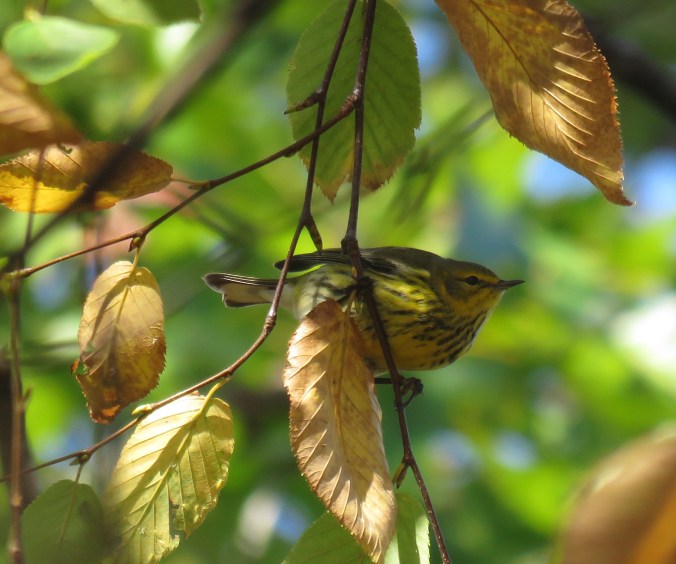
However, a closer inspection revealed our fears that the birds would no longer be active were unfounded.  Warblers slowly foraged every tree, and many were surprisingly close to the road.  We quickly found blackpoll, black-throated green, Tennessee, and Cape-may warblers, as well as unseasonably large numbers of black-throated blue warblers.

35153552_Unknown.jpg

Cape-may Warbler (Setophaga tigrina).  Photo by Tucker Beamer.

As we walked farther down the road, we saw more and more birds.  Late wood thrushes feasted alongside more seasonally common Swainson’s thrushes in thick tangles of summer grape vines, laden with purple fruit.  We found a late black-and-white warbler and an American redstart.  Scarlet tanagers swooped over the road, and black-throated blue warblers chipped over our heads.  We eventually also found magnolia, palm, pine, and yellow-rumped warblers.

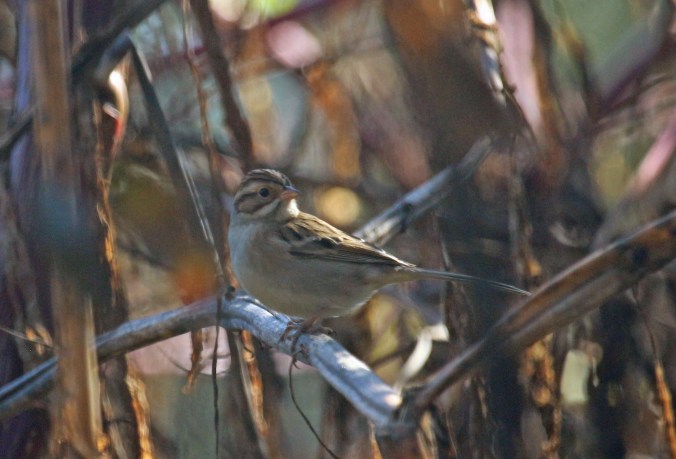
Our final destination for the day was a golf course in the Old Trail neighborhood of Crozet, where someone had seen a clay-colored sparrow the day before.  We had directions to the clump of pokeweed he had been in, and we soon found it.  As we arrived, Baxter saw the bird hop down into the dense brush.  We waited several anxious minutes for it to return, but we needn’t have worried.  It soon returned and sat preening itself on a poke stem while we watched.  The clay-colored sparrow was an Albemarle lifer for everybody, and a lifer for Max and Drew.

IMG_7135_edited-1.JPG

Clay-colored Sparrow (Spizella pallida)

When I totaled up our day list that evening, I found we had seen 72 species.  We had experienced a late Fall migration fallout, and we enjoyed ourselves very much.  What an incredible day of local birding!


Pocosin Cabin: Spectacular Fall Migration in Shenandoah National Park

I recently attended the first ever Blue Ridge Young Birder Club field trip to Pocosin Cabin in Shenandoah National Park.  I had heard great things about Pocosin, and I was very excited to finally be getting up to Greene County to visit it.  The trip was well attended, with 11 young birder participants.

IMG_1174.JPG

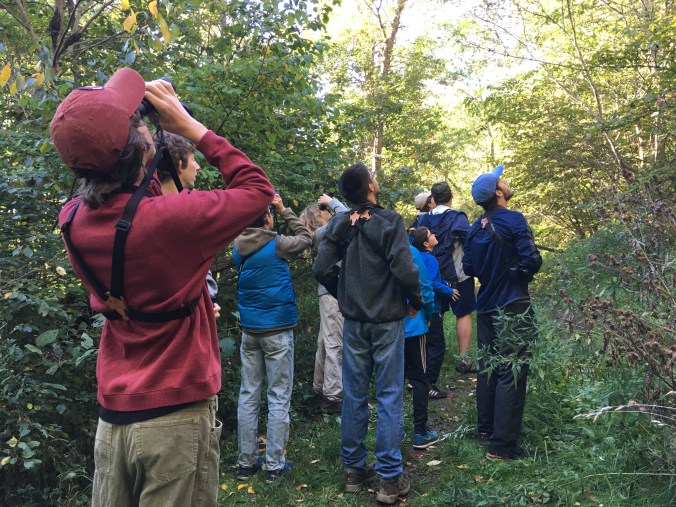
Members of the Blue Ridge Young Birders Club on the Pocosin Cabin Field Trip

As we drove up the scenic Blue Ridge Parkway, numerous species of asters bloomed by the roadside, creating beautiful drifts of blue and white flowers.  When we got out of the car at the Pocosin Cabin Fire Road, the air felt cool and crisp, a refreshing change from the repressive heat of summer.  Around us, the black gums and tulip populars were already starting to change color to deep reds and yellows, while many of the other tree species remained green.  We encountered our first mixed species flock just after we passed the clearing containing Pocosin Cabin.  Birds flew everywhere I looked.  Swainson’s and wood thrushes were common, but try as we might, we could not find the more uncommon gray-cheeked thrush.  Blue-headed vireos flew and sang from seemingly every branch.  Later season warblers foraged the canopy around us, with Tennessee, blackpoll, and bay-breasted warblers being the most common species.  We also saw blackburnian and black-throated-green warblers, and a northern parula.  In a jewelweed-covered ditch next to the trail, a gorgeous brilliant blue, black, and white male black-throated blue warbler hopped and flitted.  Good bird activity continued down the trail, and just as we were talking about how great a Philadelphia vireo would be, Max called from up ahead that he had one.  We all rushed to him, but by the time we got there, the bird had disappeared. Panicked, we started thoroughly searching the abundant blue-headed vireos for the vanished Philadelphia.  Finally the bird was re-found, and everybody had fabulous views as it foraged in a shrub directly above our heads.

IMG_6978_edited-1.JPG

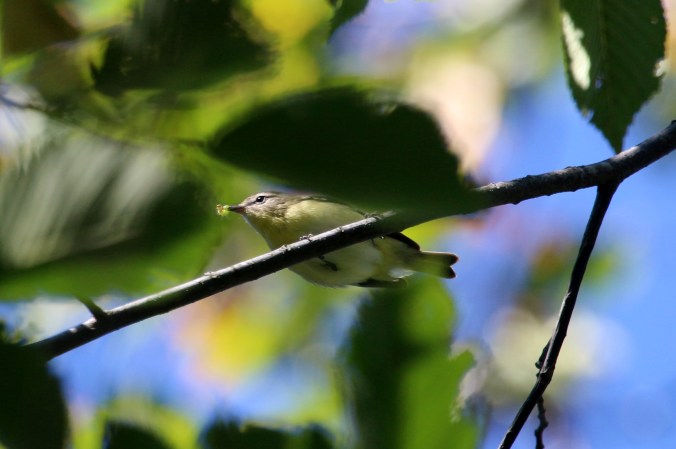
The Philadelphia Vireo eating a grub

We walked back up the fire road at a more leisurely pace, stopping periodically to look for salamanders under rocks and in the little creeks that crossed the path.  Aside from many common red-backed salamanders, Carson and Robert were able to turn up a southern-two lined salamander, and some monstrously sized northern dusky salamanders.


Kiptopeke Challenge 2017: A Birding Big Day on the Eastern Shore

I felt completely awake despite it being two hours before dawn from the anxiousness and excitement churning inside me.  My brother Theo, our friend Tucker Beamer, and I stood in the high grass of the salt marsh at Pleasure House Point Natural Area in Virginia Beach.  The sounds of the high buzzy chip notes of migrating warblers occasionally pierced the quiet as they flew overhead.  We were competing in a birding big day known as the Kiptopeke Challenge (KC) in order to see as many species as we could in a twenty four hour day, and raise money for the Coastal Virginia Wildlife Observatory (CVWO), an important conservation and field research organization in the area.  We had registered ourselves as Team Turnstone.

IMG_0013.jpg

Team Turnstone at Cape Charles later in the day

Over the past month, we had meticulously planned a birding route up the Eastern Shore of Virginia from Pleasure House Point, and we were thrilled to finally be putting our plan into action.  Suddenly, we heard the hoarse croak of a yellow-crowned night-heron as it flushed out of the grass somewhere off to our right.  The first identified species of the day!  The low grunting of resting mallard ducks drifted to us on the still night air from the water.  The raucous repeated “kek” calls of a clapper rail erupted out of the marsh and then died back.  We hurried back to the car, and drove to the Chesapeake Bay Bridge Tunnel (CBBT).

At 5:25 AM we pulled into the deserted parking lot of the first CBBT island, a famous birding spot, but not one I had high hopes for in the dark.  In the dim light of street lamps, we spotted the blobs of two sleeping shorebirds on the rocks in the surf below.  Closer inspection showed a ruddy turnstone and a sanderling, as well as two more juvenile yellow-crowned night-herons.

We were particularly excited for our next stop, a small section of bay-side beachfront in southern Northampton County called Sunset Beach.  We had heard that hundreds of warblers that had overshot during the night and found themselves on the edge of the difficult to cross Chesapeake Bay flew back up the peninsula of the Eastern Shore at dawn every day.  We found a Wilson’s warbler foraging in the brush, but not yet much else.  We arrived just as the sun was rising, and as we waited for more warblers, we birded along the beach in the half light.  We  saw common gulls, pelicans, and cormorant for the first time that day.

Coming back to the small woodlot near where we had parked, we saw that other Kiptopeke Challenge teams had gathered in expectation of the great flight.  Among them was the Blue Ridge Great Horns, the other youth team.  They were Tucker’s older brother, Baxter Beamer, Gabriel Mapel, and Max Nootbaar.   They jauntily approached us and asked how we were doing.  We asked them the same question instead of answering.  Baxter told us that they had done more pre-dawn birding than us, and as a result had some birds that we didn’t, like bobolink, Swainson’s thrush, and northern harrier.  They didn’t have Wilson’s warbler though.  All further talking was interrupted by a barrage of warbler flight calls.  We hurried to take up our position with the rest of the teams as 20 warblers streaked low over head and disappeared into the dense pines.  Over the next hour, we watched more than 600 warblers of almost 20 different species zip over the gap and up the peninsula.   It was hard to identify them from so brief a look, and to compound the problem, by KC rules, everyone in the team has to see a bird for it to be countable on the team’s list.  Even so, I enjoyed the challenge and the feeling of wonder at the sheer amount of birds.

IMG_0245-2.JPG

Northern parulas were one of the most common species on the morning flight at Sunset Beach.  Photo by Tucker Beamer

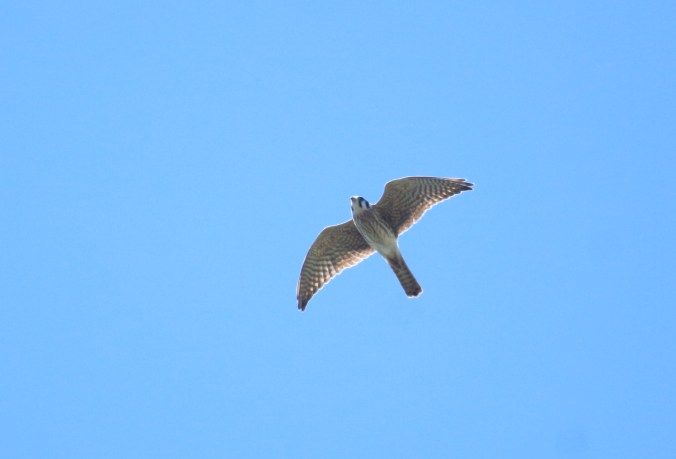
When the constant stream of warblers finally began to die down, we had around 60 species for the day, and it was only 7:40 AM.  We said goodbye to the Great Horns, and headed to our next stop, the Eastern Shore of Virginia NWR.  We hoped the other teams wouldn’t stop here, and we might be able to get some birds back on them.  We saw a beautiful American kestrel as we drove in to the refuge.

IMG_6889_edited-1.JPG

American kestrel

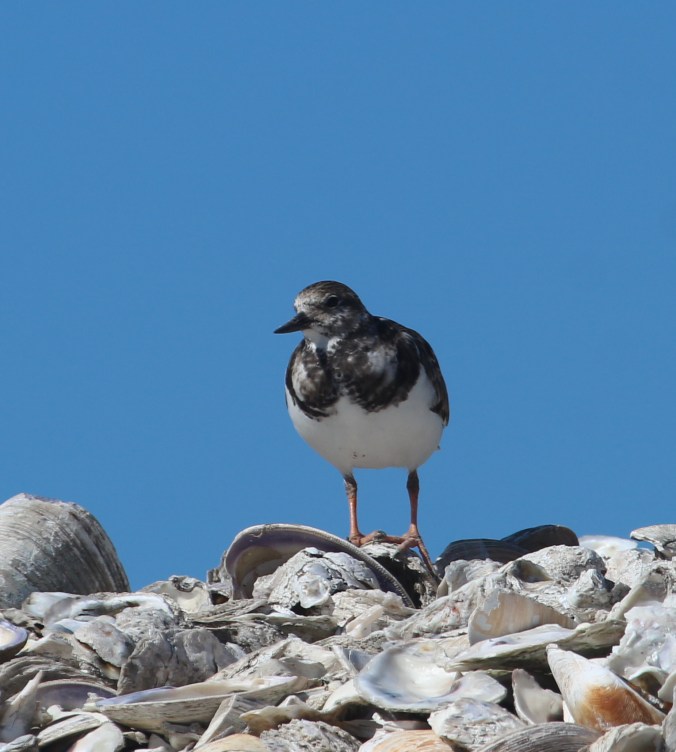
Other notable birds at Eastern Shore of Virginia NWR included sharp-shinned and Cooper’s hawk, a late eastern kingbird, and house finch, supposedly a difficult bird on the Eastern Shore.   At the Kiptopeke Hawk Platform, we were surprised by how close the migrating raptors were.  At the Rockfish Gap Hawkwatch in Augusta, the raptors appear as little specks in the sky, but at Kiptopeke most birds are low.  We saw our first confirmed merlin, as well as a tufted titmouse, a sometimes difficult species in Northampton.  We drove to Magotha Road, where we hoped to see Eurasian collared dove and marsh wren.  Sadly, the only new birds we added were peregrine falcon, least sandpiper, great egret, foresters tern, and eastern bluebird.  As we were about to leave, the Great Horns drove up again.  They asked us how we were doing again.  When they learned that we were quickly catching up to them, they left in a hurry.  We continued on to Cape Charles Beach, where we hoped to pick up the other tern species.  The sea oats on the dunes blew lazily in the midday wind.  I was beginning to feel the strain of such an intense schedule, but the terns flying by quickly distracted me.  We were only able to pick out royal and sandwich terns here, leaving us to hope we could get caspian and common at Chincoteague later in the day.  At the town of Willis Wharf’s lovely scented boatyard, (the freshest air in the place was the abandoned porta potty), we once again saw our mascot bird, the ruddy turnstone, perched atop a mountain of oyster shells.

IMG_6748_edited-1.JPG

Go Team Turnstone!

Now we had a long time in the car, as we drove all the way up to Saxis Wildlife Management Area in the most northern part of Virginia’s portion of the Delmarva Peninsula.  Seemingly endless plains of salt marsh stretched out from the road in all directions.  We got out of the car, feeling the hot sun beating down on us, and “pished” at the grass.  A seaside sparrow flew up and further away from us. We clapped half-heartedly, hoping to coax a Virginia rail into responding, but since it was literally the middle of the day, we didn’t have much hope.  After about a minute, some Virginia rail, somewhere way out in the marsh, decided it just wanted us to shut-up and let it rest.  The grunting call of the rail was barely perceptible to us, but we could count the bird.

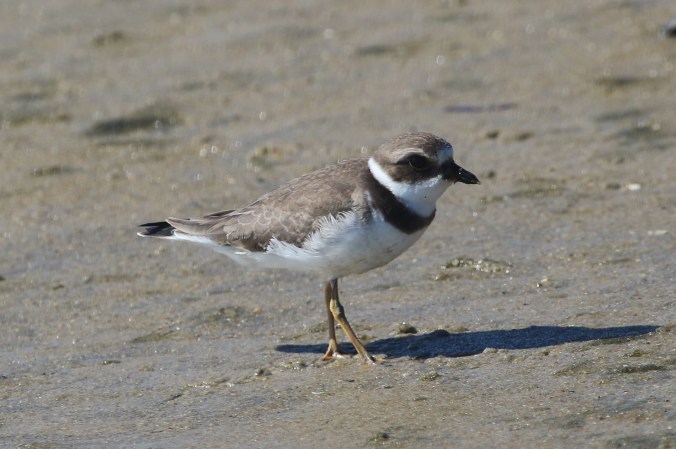
Now we could continue to our last stop, Chincoteague National Wildlife Refuge.  We had planned on spending most of the afternoon at Chincoteague, which proved to be a mistake, as Chincoteague just isn’t that good in the Fall.  We should have spent more time birding sites in Northampton County.  But Chincoteague is always pretty good, and we weren’t entirely disappointed.  We were disappointed by the number of people using the beach.  Why on earth does every beachgoer in the world have to decide to come out to a wildlife refuge when they could literally choose any other spot of sand?!  The beach was so crowded, you could hardly see the ocean from behind the lines of sunbathers.  We hurried past, toward the Tom’s Cove mudflats where we hoped for shorebirds.  One of the first birds we spotted was my Virginia lifer piping plover.

IMG_6801.JPG

Piping Plover posing for photographs

Shortly afterward, we found a sandpiper flock, with some semipalmated sandpipers, sanderling, and semipalmated plovers.  There was also a least sandpiper, and many black-bellied plovers.  These were all new birds for the day, except the least.

IMG_6800.JPG

Semipalmated Plover

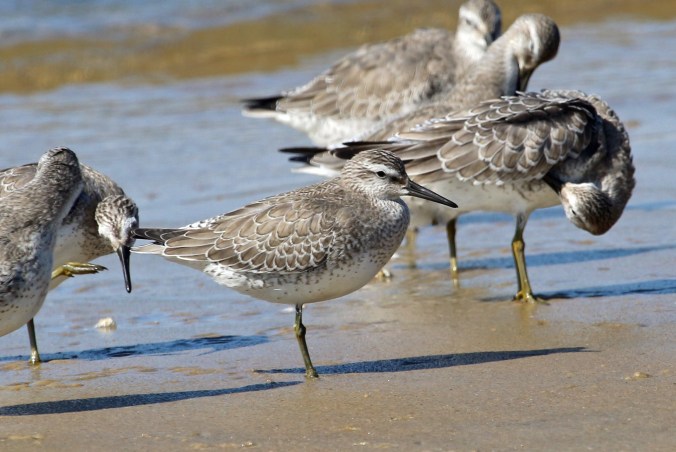
As we continued down the beach, we were surprised by the lack of willits and marbled godwits, which should have been common.  Up ahead, we saw a giant flock of gulls and terns and decided to scan it.  They were mostly great-black backed, herring, ring-billed and laughing gulls and royal terns, but we were able to find caspian and common terns mixed in as well.  Suddenly, a flock of  31 red knots flew in from the ocean side, and landed nearby.  This was a day-bird and Virginia lifer for me.

IMG_6798_edited-1.JPG

Red Knots preening

We birded around Chincoteague for the rest of the day.  Highlights included an adult Lincoln’s sparrow, a bird never before seen on the Kiptopeke Challenge, that we spotted on the Black Duck Trail.

img_0478-e1506433730634.jpg

Lincoln’s Sparrow.  Photo by Tucker Beamer.

As the sun was setting, we hurried back out to the beach to give willits and marbled godwits another shot.  As we walked down the now empty beach, massive flocks of willets and red knots were everywhere.  We were able to pick out four marbled godwits in a flock of over 50 willits.  Thank goodness we eventually got those birds!  After dinner, we came back out to the refuge to try for owls and nocturnal migrants, but we came up with nothing new.  We had planned on listening for more nocturnal migrants back at our hotel, but I guess the beds just looked too good.  It was 10:30 PM, and we had been up since 4:00 AM.  We went to bed.  Our total for the day was 107 species, perhaps not as good as we hoped, but still a fairly solid number, and we’ll be back next year to do better.

Virginia Breeding Bird Atlas

I crept forward through the dense understory of spicebush, trying not to make too much noise, as I followed the soft, incessant trills of a fledgling begging call. I was birding in a small valley right next to our house in the hope of getting a wood thrush breeding confirmation, as we had heard many singing down here recently.  As I removed the final branch blocking my view of where the calls seemed to be coming from, I saw the fuzzy reddish brown backs of 3 little thrushes hopping around on the ground.  I snapped a quick photo and then left them alone.

The 2nd Virginia Breeding Bird Atlas (VABBA or VABBA2) is an ambitious citizen science project designed to document the distribution and abundance of Virginia’s breeding birds.  This year, I participated in the VABBA to learn more about our breeding birds and my local area, and to promote bird conservation through citizen science.  This year was the second of the five-year project, and my first as a volunteer.  Virginia is divided into nearly 4,400 nine square mile blocks, ideally each of which would be surveyed completely.  In recognition that complete survey is very unlikely, one out of every six blocks is a priority block, a designation given to attempt to focus efforts more evenly across the state.  There are approximately 798 priority blocks in Virginia, of which 570 now have data.  VABBA block survey consists of attempting to identify and document breeding evidence for as many species of birds as possible, across as many different habitats in the block as possible.

Through the second season of this project, I have been amazed by the ability of the birding community to contribute large quantities of important data.  The VABBA2 has received 37,669 checklists from 742 participants in just its first two years.  Atlas volunteers have confirmed 185 breeding species in Virginia.  The first VABBA, held over 25 years ago, only confirmed 196 species in five years.  So far I have confirmed 34 species in my block, with an additional 16 as probable, through 45 checklists.

This year I signed up to be the principle atlaser for the block that we live in, Greenfield Central West (CW).  It is not a priority block, but I didn’t want to have to drive somewhere else to bird and I wanted to learn more about the ecosystems around our house.   I was also happy to get to know more local property owners through asking them for permission to survey their properties.  Our immediate neighbors have been very accommodating to birding, and we have unlimited access to a large chunk of land adjacent to our own.  Participating in the Atlas was an opportunity to expand this access to other properties nearby.

I have really enjoyed my participation in VABBA2 this year, but have also found it challenging.  I learned a lot about the breeding biology and behaviors of our summer species, including the habitats different species favored, and I expect to learn much more next year.   Now I know, for example, that I can reliably find ovenbirds and worm eating warblers in the dry oak hickory forest on the Paul’s Creek Trail in the foothills of the Blue Ridge.  These are two species that I don’t expect to find breeding in the lush floodplain forest on our property in the same block, less than a couple of miles away.  Similarly, I hoped to find breeding hooded warblers as the elevation increased, and was pleased when I was able to confirm one.  I also began to learn which behaviors distinguish a bird that is likely to show breeding evidence.   For instance, a bird silently feeding in the brush or flying directly back and fourth between shrubs is much more likely to give you a breeding confirmation than a bird singing leisurely in the canopy.

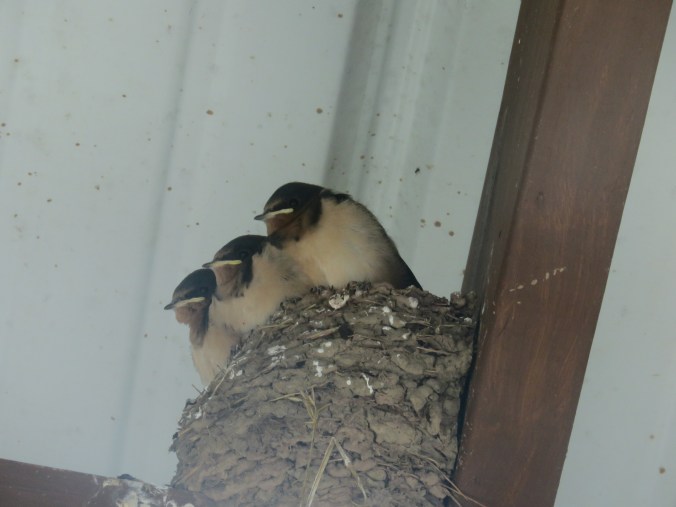
IMG_0997.JPG

These Barn Swallows illustrate the confirmed breeding code Nest with Young (NY).

As I learned more about the differences between atlasing and regular birding, I was able to confirm many more new species per atlasing venture.  Like regular birding, atlasing consists of looking for and identifying birds, but when atlasing, you must also observe and rank breeding behaviors. There are four categories of breeding behavior: observed, possible, probable and confirmed. The goal is to observe the highest possible category for each species. For example, you might see a singing male in the same spot more than seven days apart (a ‘probable’ behavior), but you aren’t done with that species until you have observed it exhibiting a ‘confirmed’ behavior, such as feeding young. To observe so much, you have to move slower, and pay more attention to any given bird than you would in regular birding.

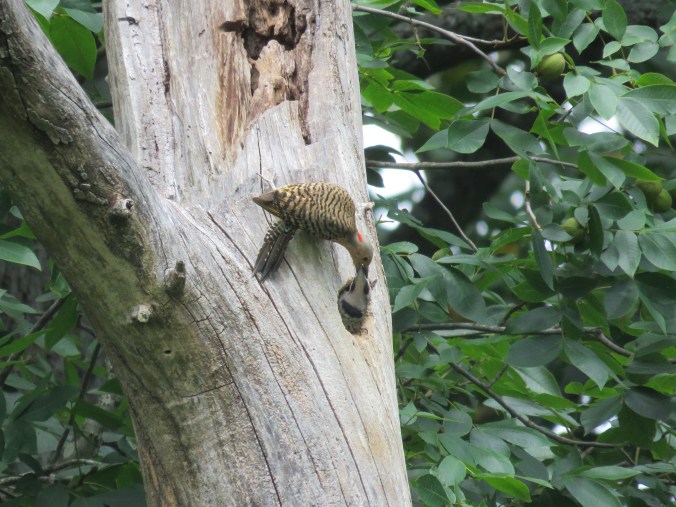
IMG_7882.JPG

This Northern Flicker Feeding Young (FY), was observed at McIntire Park, Charlottesville, VA.

On one atlasing trip in early spring, I made a visit to a farm in my block with some large fallow fields to look for displaying American woodcocks.  I knew I wouldn’t be able to confirm them, as they nest on the ground in dense vegetation and blend in so perfectly that even when you know one is right in front of you, it still might take you five minutes to see it.  Despite this, I was excited to get the probable display code on them and witness their strange display flight again.  Right as it was getting so dark I was worried we wouldn’t find any, the strange dry “peeent” of an American woodcock came from across the field, followed by the sharp twittering as it flew overhead.  We heard two or three more birds that night.

One of the aspects of atlasing that I found most challenging was figuring out the timing of the breeding season.  There are species breeding almost all year, with species like bald eagle and great horned owl starting as early as December, and the smaller owls and raptors soon following.

IMG_5049.JPG

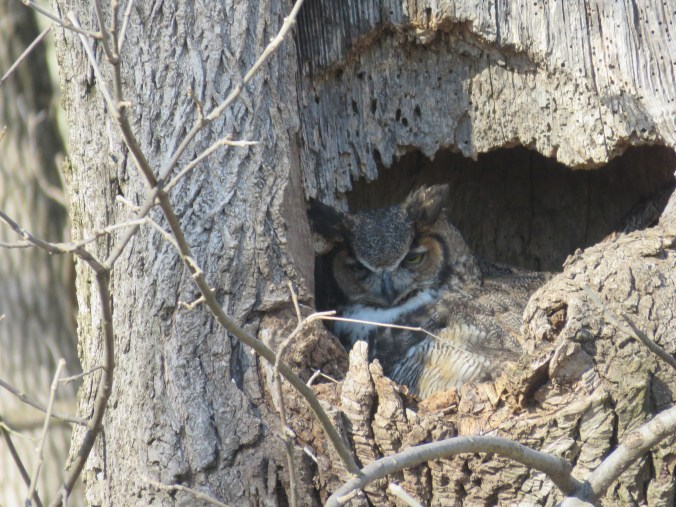
This Great Horned Owl was observed on March 9nth, at Thomas P. Grater Community Park in Lancaster County, Pennsylvania, which is not in the VABBA2 area.  This would be the Occupied Nest (ON), confirmed breeding code.

However, the vast majority of our breeding species, the neotropical migrant songbirds, are easiest to confirm during June and early July.  I remember feeling full of energy and having plenty of time for atlasing during March when only a few species were breeding.  In May and June, though, we went to the Biggest Week in American Birding in Ohio, and to Glacier National Park, plus many weekend birding trips around the state.  By late June when most species are breeding, I felt stressed and worried that I wouldn’t have enough time to confirm a decent number in my block this year.  My stress was exacerbated by my inexperience with the VABBA protocols because I didn’t know at the outset where to focus my effort and attention.

Overall, atlasing has been a very educational and rewarding experience for me, and although this breeding season is finishing up, I am looking forward to finishing my block next summer.