Green Swamp Preserve: Orchids and Carnivorous Plants

Every year, my family makes a trip to Emerald Isle in the outer banks of North Carolina. This year, one of the birds that I most wanted to see was the secretive Bachman’s sparrow of southern pine savannas.  Two young birders from the Carolinas whom I met in Glacier National Park earlier this summer told me that the most reliable spot to find Bachman’s sparrows nearish Emerald Isle was the Green Swamp Preserve in Brunswick County, near the border of South Carolina.  A quick look at ebird confirmed this information.  The Nature Conservancy’s website’s claim of “many orchids and insectivorous plants” was all the extra encouragement I needed to make the two-hour drive.   When we pulled into the small dirt parking lot, it was already getting hot.  We briefly scanned a small pond next to the road, and found one anhinga, an overdue NC lifer for me.

As we started down the trail, the sun beat through the sparse canopy of longleaf pine.  After awhile, the path started to become more wet and boggy.  Theo spotted the first venus flytrap growing in a little muddy ditch.  A few minutes of searching revealed many more, in small sphagnum clumps, their colors and sizes ranging from little green plants just an inch wide, to three or four inch plants with rich red traps.  This photo shows one of my favorites.

IMG_5676.JPG

Venus Flytrap (Dionaea muscipula)

The dense clumps of pineland threeawn grass thinned out more as the ground became boggier.  I saw some tiny bug eaten yellow pitcher plant clumps, and rushed to photograph them.  Just as I was almost there, I spotted a small brilliant orange lily in the grasses.  Correctly assuming it was pine or Catesby’s lily, I switched plants and went to photograph it.  What a colorful little lily.

IMG_5618_edited-1.JPG

Pine Lily (Lilium catesbaei)

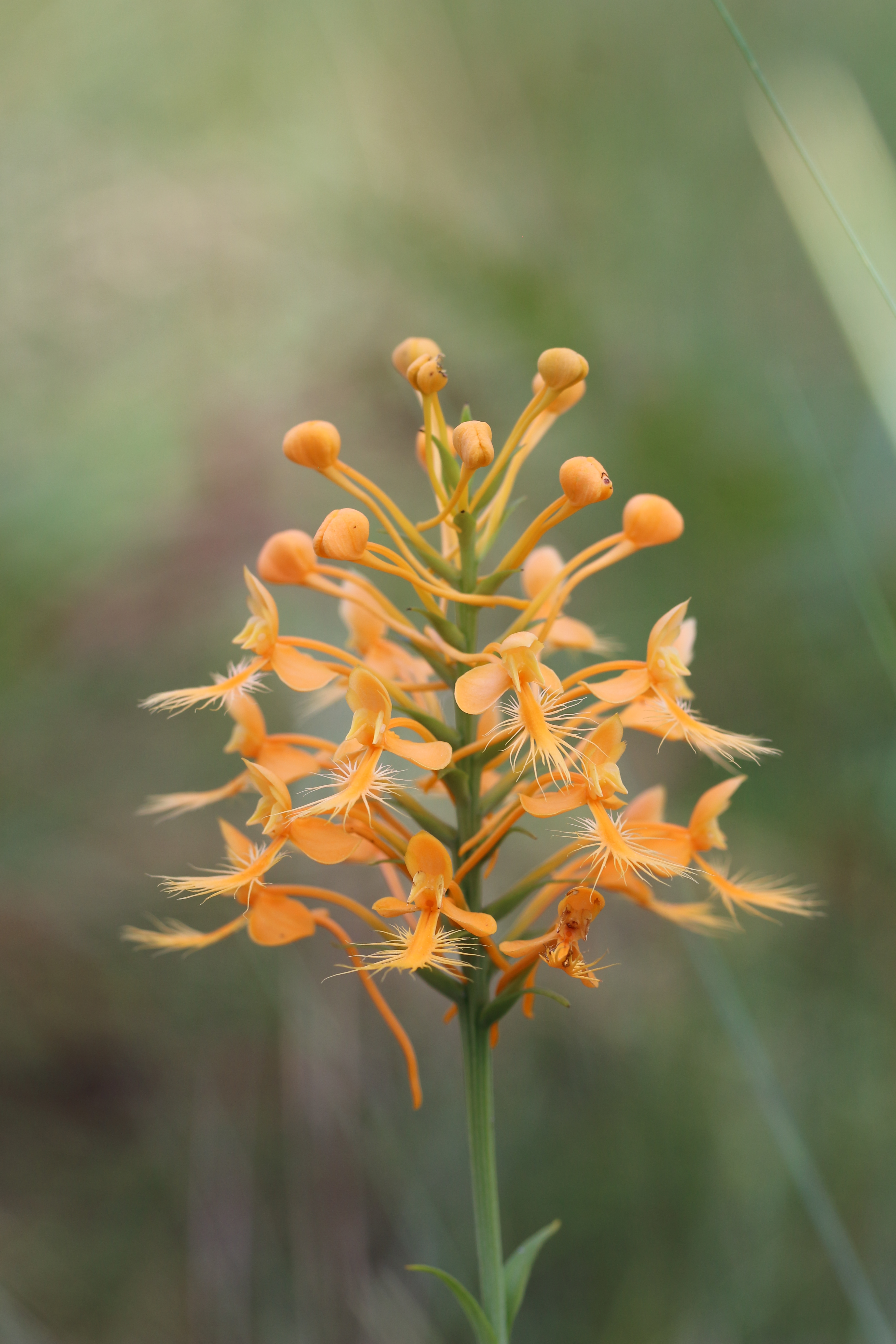
Next to the yellow pitcher plants, there were several southern purple pitcher plant clumps, their foliage tinted a deep red from the relentless sun.  I have seen the purple pitcher plant species in West Virginia, but those plants belonged to the northern subspecies, (Sarracenia purpurea subsp. purpurea), not the southern subspecies (Sarracenia purpurea subsp. venosa) that grows in pine savannas.  Over the pitcher plants, the tall, white, ball-shaped flowers of ten-angled pipewort bobbed back and forth, disrupted by my movement.  I looked up in time to see a female Amanda’s pennant flit up and perch on a stick, a lifer Ode for me.  Poking around the clump of grass, the orange inflorescence of an orange fringed orchid caught my eye.  I would have been thrilled about this only a few days before, but we had stopped and photographed a roadside colony in Croatan National Forest on the drive to Emerald Isle.  The orchids I was really hoping to see were the other platanthera  species that grow in savannas like this, such as white-fringed, yellow fringeless, or orange crested.  Despite my previous sighting, it was still an exciting plant, and maybe it was a good sign of better things to come.

IMG_5623.JPG

Orange Fringed Orchid (Platanthera ciliaris)

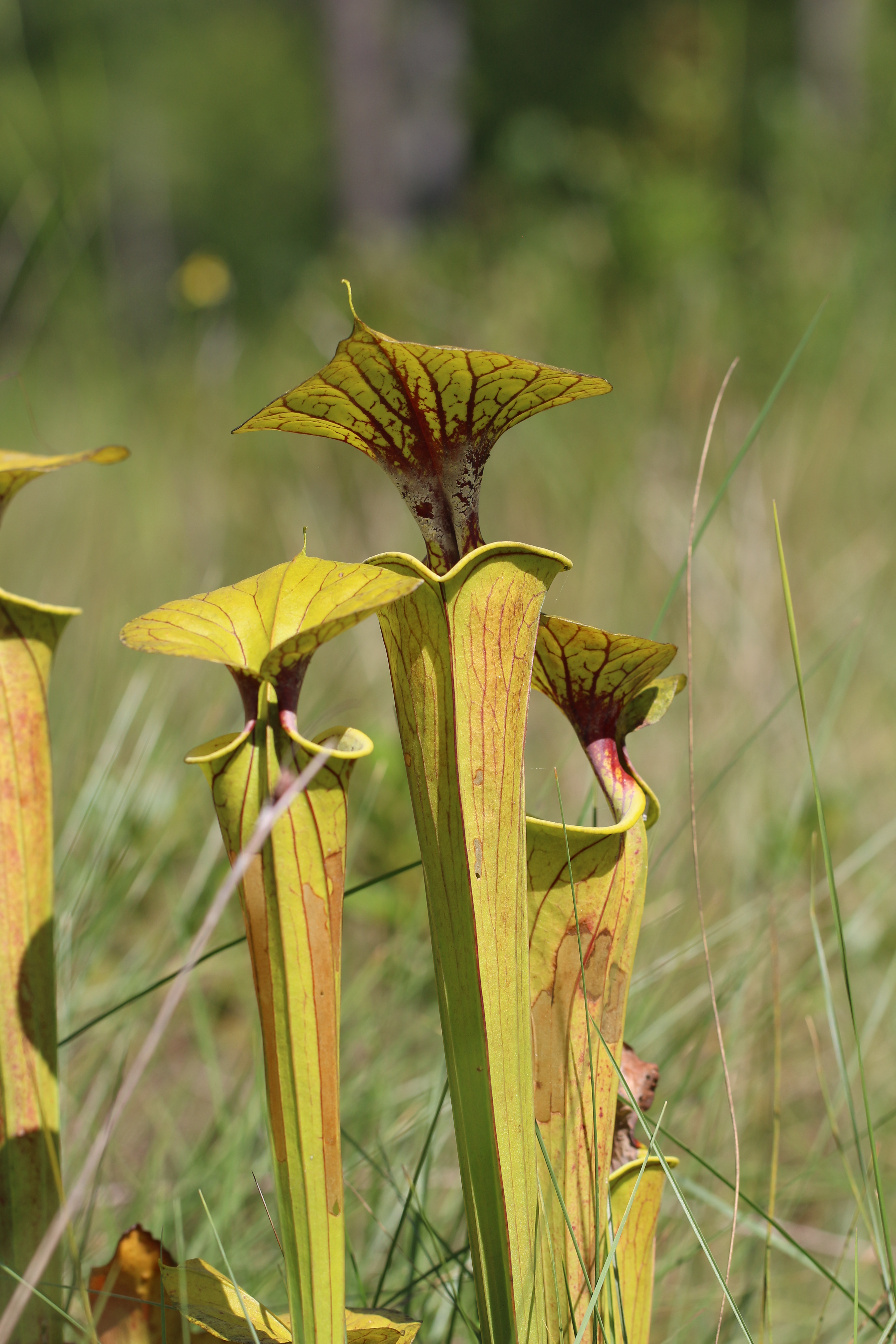
The longleaf pines opened up even more as we walked through a brightly lit glade.  Large, lush carpets of pineland threeawn grass and other herbs carpeted the wet ground, interspersed periodically with the bright spike of an orange fringed orchid.  Huge clumps of healthy, yellow pitcher plants rose out of the grass.  It’s been a few days, but I don’t think I’m exaggerating in saying that some were more than 2 1/2 feet high!

IMG_5634.JPG

Yellow Pitcher Plant (Sarracenia flava)

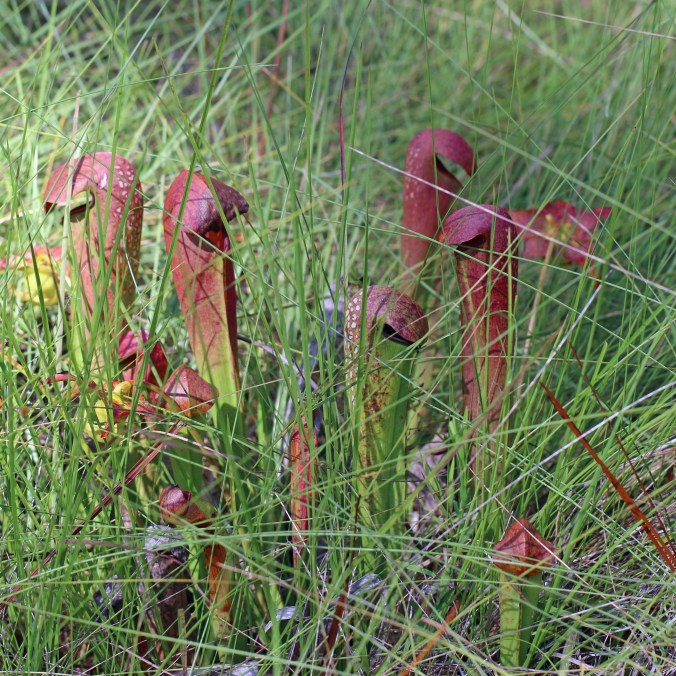
Grass-leaved Barbara’s buttons, blazing star, elephant’s foot, many species of meadow beauty, and other colorful flowers bloomed in the meadow around us.  We finally found a clump of hooded pitcher plants almost buried in the grass.

IMG_5684_edited-1.JPG

Hooded Pitcher Plant (Sarracenia minor)

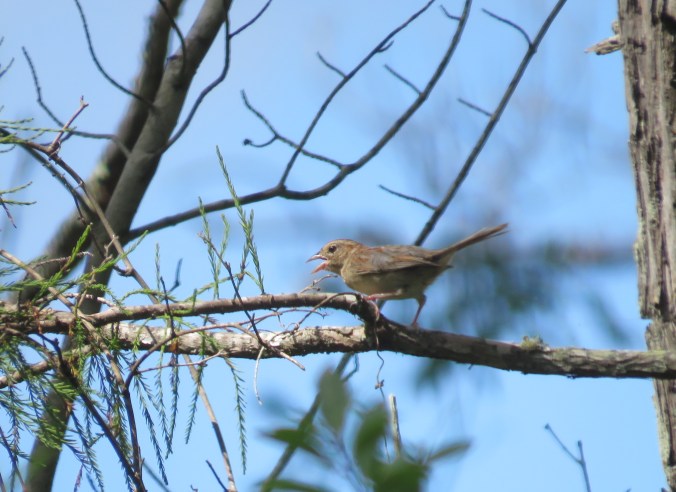
Nearby was a small red pitcher plant group, completing our four pitcher plants for the day.  Leaving the sunny glade behind, we plunged into a thick tangle of southern swamp growth.  By this time, the trail was a stream of blackwater bordered by impenetrable vegetation.  We could not see when the path would leave the swamp, and indeed didn’t know if it would.  We pressed on, as we didn’t yet have our guaranteed Bachman’s sparrow, the original reason for this trip.  We continued through a series of openings into the longleaf savanna and than plunged back into the dark, wet, swamp.  In one such opening, we heard the high, trill of a Bachman’s sparrow and then spotted it.  I had thought they wouldn’t be singing this time of year, so I was quite surprised to hear it.  We were able to watch the bird for a long time, before it finally hopped back off its branch and returned to the grass.

IMG_1939.JPG

Bachman’s Sparrow (Peucaea aestivalis) Photo Credit: Theo Staengl

A few plants still eluded us, so we decided to follow the trail to its end.  That was a mistake.  Just as we were finally getting ready to turn around, my brother strayed a little further down the trail.  When he came back, his legs looked like they were covered in dust.  He had stepped in a tick nest for the third time this summer!  I did the natural thing, looked down at my legs, and was hardly surprised to see that I had some on me as well.  But just a few hundred, nothing like Theo or my dad.  After half an hour of inefficiently picking ticks off our legs, we decided to go back and try not to worry about the rest till we got to the beach house.  Walking back through one of the forest openings, I found this one, pathetic, tiny, awful, old, orange crested orchid.  It isn’t much for a life plant, but it is the only one we found.

IMG_5674_edited-1.JPG

Orange Crested Orchid (Platanthera cristata)

An excellent trip, minus the ticks.


An Epic Bird Finding Guide

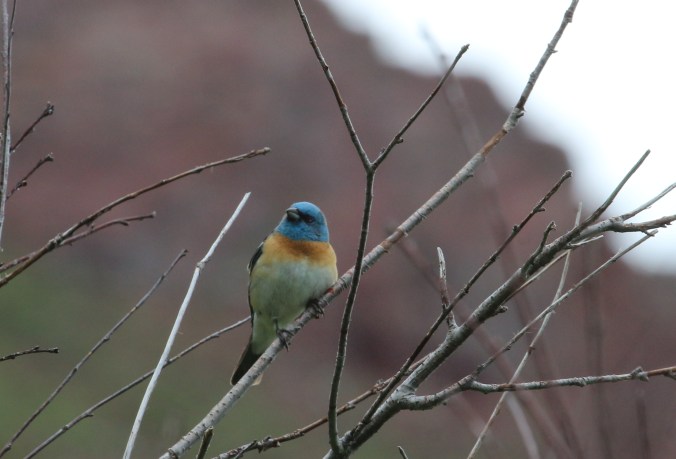
We hiked up a steep incline to arrive at a beautiful wildflower meadow.  The brilliant oranges and reds of Indian Paintbrush contrasted starkly with the bright white Beargrass.  We had chosen the Iceberg Lake trail in Glacier National Park because of the enticing description in our birding guide, “Glacier is for the Birds.”  From our lofty perch, we scanned the tops of the extensive spruce/fir forest in the valley below us.  We could see numerous waterfalls and cliff faces covered in wildflowers on the mountainsides around us.  Suddenly, an iridescent caramel-colored speck whizzed up the valley.  The male Rufous Hummingbird landed at the top of a nearby spruce, giving us fantastic studies of its sparkling gorget and back.  We were quickly distracted from our quest to get a photo that really showed the iridescence of the hummingbird by the call of a Dusky Flycatcher coming from further upslope.  We soon found the bird perched in the top of a bush, but I listened more than I looked, as Empidonax flycatchers are extremely hard to identify by sight.  “Glacier is for the Birds'” predictions were proving amazingly accurate: “As you proceed through the shrubs and until you head back into the trees, listen and watch for Dusky Flycatchers, Orange-crowned Warblers, MacGillivray’s Warblers and Lazuli Buntings,” though we still hadn’t seen any Lazuli Buntings.  After more searching of trees and listening for calls, we finally located a male Lazuli Bunting singing in a bush.  After the first one, they seemed to be everywhere, and we enjoyed many views of this spectacular bird.

IMG_3539_edited-1.JPG

Lazuli Bunting (Passerina amoena)

We paused every mile or so and checked the book again, as it provided so much detail we couldn’t remember it all.  Next was “Past the Red-rock outcrop, look for Pine Grosbeaks until you are in the trees.”  As soon as we had fully rounded the next big projection of Glacier’s famous “red rock,” a male and female Pine Grosbeak flew off the path into the top of a large fir.  They stayed there only a few seconds, giving us just enough time to get a decent look, and then flew away.  That was the only time we saw Pine Grosbeaks on our trip.

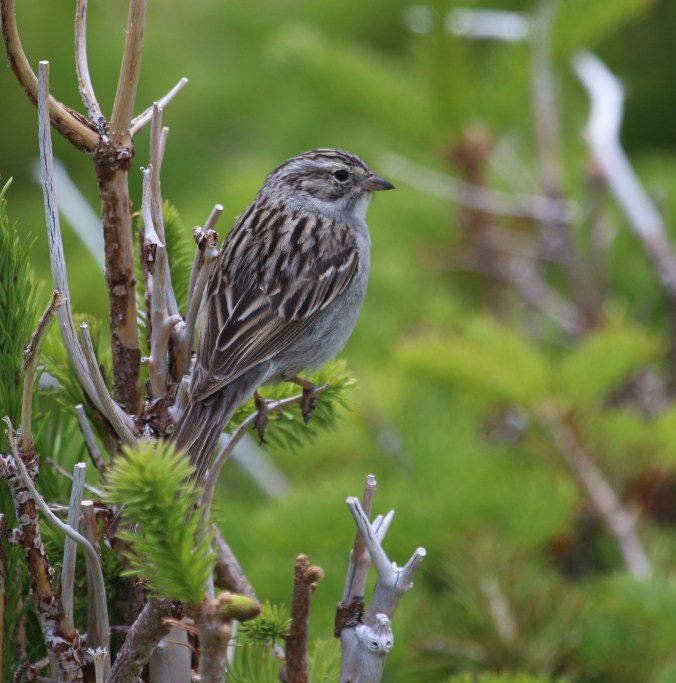
My experience in Glacier National Park convinced me that a good bird finding guide is essential for travel, even though I usually rely heavily on eBird for local birding information.  EBird is a global citizen science project by the Cornell Lab of Ornithology that gathers birders’ sitings into a massive database, which they make available to the public.  I have been eBirding since I started birding, and I can’t imagine birding without it.  EBird is a fantastic tool for keeping personal lists, finding target birds, and learning basic information about a location, but you still really need an actual book.  Some regions are poorly ebirded, leading to small and useless amount of data.  Some regions lack solid internet connection (like Glacier), making it impossible to use.  EBird also lacks the level of detailed information about bird finding often found in bird finding guides.    For instance, on one hike we did to find Timberline Brewer’s Sparrow, our book told us not only which trail but exactly which switchback to look for the sparrows’ territories.

IMG_3946_edited-1.JPG

Brewer’s Sparrow (Spizella breweri)

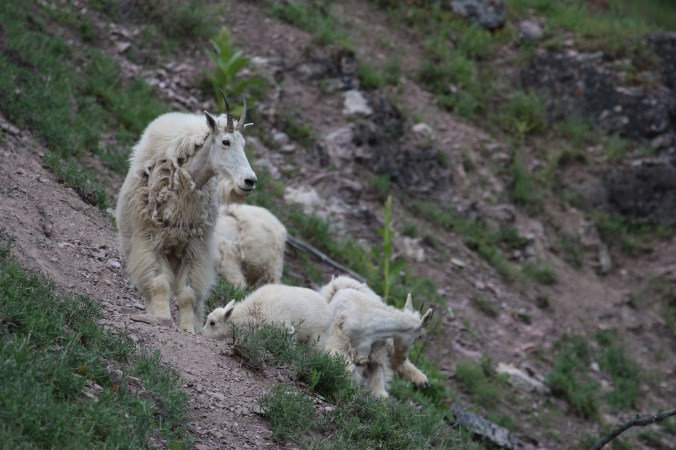
Finding the Brewer’s Sparrow wasn’t the only time the guide proved so precise it made our jaws drop.  One of the few target birds we hadn’t found by the end of the trip was the Evening Grosbeak.  The guide recommended a brief hike at Goat Lick for it.  We decided to stop there on our last day heading out of the park.  That day ended up full of excitement (see previous post) and we felt like we had to skip the Goat Lick hike as we figured we couldn’t afford the time to look for the bird.  As we were driving, we saw a crowd gathered on the side of the road.  Was it a bear jam, we wondered?  Nope, it was goat jam.  A family of five Mountain Goats were standing right next to the road!

IMG_4064.JPG

Mountain Goat (Oreamnos americanus)

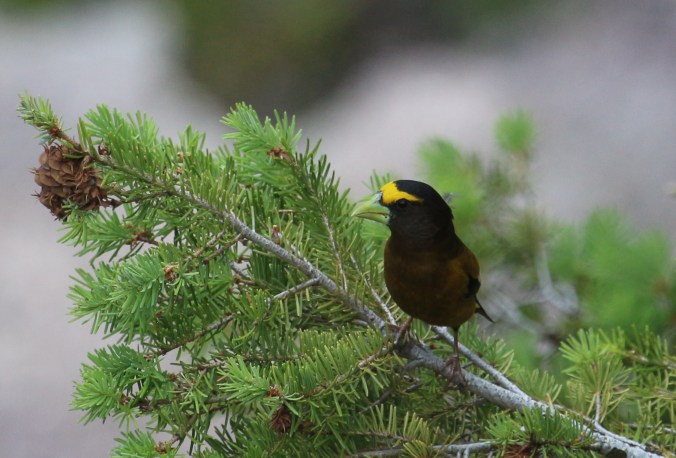
After a week of being in the park, we had seen many Mountain Goats, but they had all been distant specks way up on ridge tops.  Apparently, they come from miles away to Goat Lick to ingest minerals from the rocks like calcium, phosphorus, magnesium, and sodium.  The opportunity to photograph these amazing animals was too good to miss.  I didn’t even bring my binoculars, not knowing this was also the place mentioned in the book for Evening Grosbeaks.  Soon, the goats moved under the bridge and out of sight.  As we were about to go, a little yellow-and-black blob flew up the canyon, chittering wildly, and landed in a spruce near the bridge.  It was immediately followed by four more Evening Grosbeaks.  They were so close and bright, I didn’t really mind not having my binoculars.

IMG_4088_edited-1.JPG

Evening Grosbeak (Coccothraustes vespertinus)

One of the things that made this bird finding guide so accurate was it was super up to date, published only last year.  Most of the birds he talked about still occupied the same territories they did last year, although I don’t really know they were the same individuals.  Older guides can still be useful, though.  On a trip to Florida last winter, I purchased the ABA/Lane “A Birder’s Guide to Florida,” by Bill Pranty, published in 2005.   I was saddened and disappointed several times during our trip when the birds he mentioned were gone and the described habitat looked very degraded or had even disappeared all together.   But despite being more than 10 years old, it was still full of great information, detailed directions, the authors personal advice, and great maps in a portable, accessible format.    In combination with eBird, it was very helpful in planning and accomplishing our trip.

One time in Miami, I looked on eBird for recent reports of Cave Swallows, a species that I really wanted to see.  There were no recent reports, but the bird finding guide had a nearby bridge staked out as a Cave Swallow nesting site.  Was it possible, 10 years later, that there could still be swallows under that bridge that hadn’t been reported on eBird? We drove quickly into the growing darkness to find out.  Upon arriving, my first impression was of an old, deserted bridge over a filthy canal, surrounded by busy highways.  Not a hopeful sight.  We searched the canal, under the bridge, and the surrounding area but saw no birds.  As we were getting ready to leave, my brother, lagging behind as usual, called from under the bridge that he saw a Cave Swallow.  He used his flash to illuminate the dark underside of the bridge once we were ready, and for just a second, I saw a little nest with a Cave Swallow peeping up out of it.


The Great Ptarmigan Hunt

Since I began researching birding in Glacier National Park nearly a year ago, one of the birds that I most wanted to see was the White-tailed Ptarmigan.  I liked that Ptarmigans are unusual — rare, range -restricted, cute quail-like birds.  Ptarmigans live in harsh, alpine environments far above the tree line.  Getting up to their snow-covered habitat in late June, when we were going to the park, could be a challenge.   They have thickly feathered feet and even feathers around their nostrils to help them deal with the cold.  Every winter, they molt out of their speckled brown breeding plumage into a beautiful snow white plumage for camouflage against the snow.  These specialized adaptations have helped ptarmigans survive the cold, northern winters for millennia, but in a rapidly warming climate, they could be fatal.

When I was researching Glacier, I bought a bird finding guide called “Glacier is For the Birds” by ranger and biologist David Benson, who studies the effects of climate change on White-tailed Ptarmigans in the park.  The book was very useful in learning what birds we could expect to see on the different trails, and more generally, some basic ecology of the park.  While we were at Glacier, we had the opportunity to go on a bird walk with Dr. Benson.  We had already seen all the common birds in the area of the walk, but we went for the chance to pick his brain about ptarmigans and couple of other target birds.  He told us that the best place to see White-tailed Ptarmigans in the park was Logan Pass, but that this was a difficult time of year, since the Going-to-the-Sun Road (the only way to get to Logan Pass) was closed to all vehicles due to snow.  Also, the ptarmigans don’t have chicks or flock this early in the year, so if we saw one, it would likely be by itself.  He didn’t sound very encouraging. When we pressed him about our chances, he kind of raised his eyebrows and said,  “Well, you can try ….” He said to scan every patch of exposed rock downslope from the Hidden Lake Nature Trail, and if we didn’t find ptarmigans there, to walk up and scan the higher rocky patches.

Dr. Benson also pointed out that, unfortunately, there were less White-tailed Ptarmigans at Logan now than there used to be, probably because of declining moisture levels due to climate change.  At this point he thought there were only about 16 breeding adults left there, less than half the number that had been there 50 years ago.  Ptarmigans get stressed by temperatures over seventy degrees, and need snow or snowmelt to cool themselves down.  Less snow and earlier snowmelt makes it harder and harder for them to cool themselves down sufficiently.

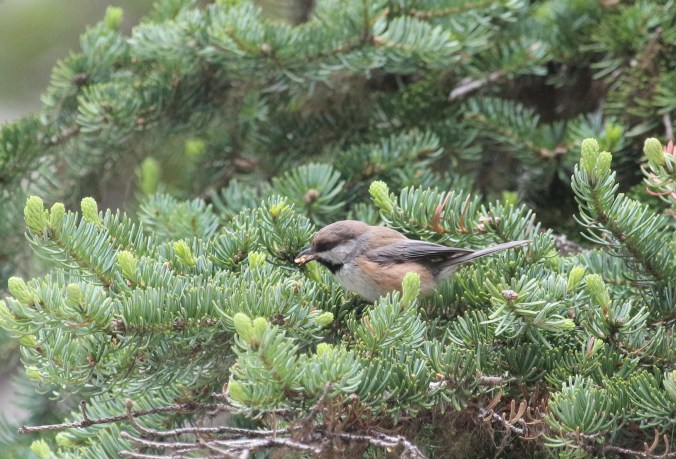
Three days previously, we had attempted to find Ptarmigans at Piegan Pass, a high pass through the mountains separating the center of the park from Many Glacier where we were staying.  According to Dr. Benson’s book, a small number of Ptarmigans could be found along the barren, rocky top of the ridge line at the pass.  The five mile hike to Piegan Pass from Jackson Glacier Overlook where we left our car was almost deserted.  Flocks of Pine Siskins and Cassin’s Finches foraged on the clean white snow beneath the stunted forest of Sub-alpine Fir.  The mountain felt pristine and peaceful, exactly how I had always dreamed of mountainous coniferous forests.  I saw the blur of a wing out of the corner of my eye.  Turning I caught a Boreal Chickadee slipping into a fir.  Soon we were surrounded by Boreal and Mountain Chickadees, and Red-breasted Nuthatches.

IMG_3628_edited-1.JPG

Boreal Chickadee (Poecile hudsonicus)

It wasn’t long before the poorly traveled trail completely disappeared into the snow.  We wandered towards the wall of mountain peaks up ahead, trying to find a footprint that might show where the trail went.  The first people we met were two cross-country skiers, apparently miffed that a family of hikers was attempting to get to the pass.  They told us that they wouldn’t recommend traveling the trail without “trekking boots” or skis.  They emphatically gestured to the snow covered treeless peaks and said the Piegan Pass trail crossed “dangerous snow fields.”  We hoped they were exaggerating.  As we continued to flounder about, trying to find the trail, we heard a loud, raucous noise from the dark sky above us.  Looking up, we saw two large, gray birds with black wings swooping between  tall spruce trees.  We felt cheered by the Clark’s Nutcrackers, another life bird to keep us going.

Upon emerging from the trees, we were surrounded by steep slopes of flaky red and brown rocks, and the occasional stunted fir that managed to survive the harsh conditions.  We could see the trail crossing the peaks in front of us – a thin, straight line, mid way up the steep slopes.  Once we had climbed up to the trail, we could see the whole valley below us, and in the distance, Siyeh Bend in the closed portion of Going-to-the-Sun Road.  Periodically, thick bands of icy snow crossed the path, from the exposed peaks down to the trees far below.   The only birds we saw were two Mountain Bluebirds huddling near the tree line.  As we crossed one of the snowfields, our shoes barely digging into the steep, slippery surface, a man carrying a large backpack came around the bend.  He was extremely exuberant and cheerful about the difficult hiking conditions, in stark contrast to the skiers we had met earlier.  He told me and my brother that the “funnest thing to do in the park” if we had snow pants and an ice axe, was to slide down the snowfields all the way to tree line and meet up with our parents at the bottom of the valley.

Continuing along the path, we stumbled and slid over three more ice sheets with the wind roaring up from the valley and pushing us against the mountain wall.  We almost made it to the pass, stopping periodically and scanning the hillside on either side of us for Ptarmigans.  We knew they might blend in perfectly with the surrounding rocks and didn’t want to miss one in plain sight.  Right before we got to the pass, a steeper ice sheet stopped us.  We were so close, but still just too far to clearly see the rocks there with our binoculars.  How infuriating!

The thought of traveling back over the exposed, icy snowfields with the wind whipping up the valley harder than ever and back down through the snow-covered forest sounded hellish.  Alas, we did not have snow-pants and an ice-axe to slide all the way down!  Still, when we peered down to the road with our binoculars it looked like if we bush-whacked straight down we would encounter a lot less snow.  Once we came out on the road at Siyeh Bend, we could walk back to our car.  We followed the trail back only until it wasn’t too steep to go straight down the mountain.  As we made our way down the rocky slope, my brother suddenly called from ahead that he saw a Gray-crownd Rosy-Finch.  I nearly broke my ankle trying to get to him before it flew away.  It was the first time I had ever seen a Rosy Finch, and I was extremely happy about it.  Several hours later, we emerged on the road, having had an adventure, but not having seen a Ptarmigan.

Earlier in the week, a ranger told us that we could hike four miles from the road closure up to Logan Pass along the Going-to-the-Sun road on weekends, but not on any other days (due to work crews on the roads).  Since we were flying home on Sunday, this meant that if we wanted to go to Logan Pass, Saturday was our last chance.  We got to the Jackson Glacier Parking lot before almost everybody else Saturday morning.

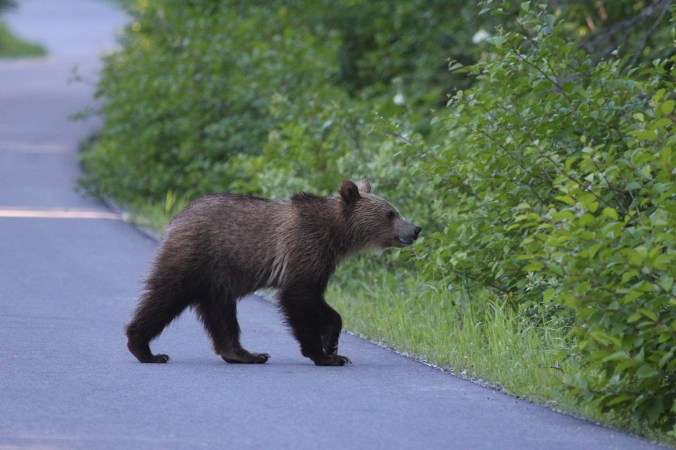
Starting out on foot, the road was wet with dew and early morning rain.  Suddenly, I heard something rustle in the brush to the side of the road.  I drew back as a mother Grizzly Bear and her cub walked across the road.  I was so intent on watching them that I forgot to reach for my camera until it was nearly too late.  I did manage one good shot of the cub as they disappeared into the trees on the other side of the road.

IMG_3951.JPG

Grizzly Bear Cub

We enjoyed the views of the many valleys, mountains, streams and glaciers as we walked.  The only people we saw were a few bikers.  The four miles went by surprisingly quickly, and we soon found ourselves at the Logan Pass Visitor Center, which was closed.  The mountain air was clean and sharp.  The 8 foot high Sub-alpine Firs that had been growing over the last half mile of the road finally stopped, giving way to pure, white snow.  A four foot snow pack covered the ground, running from the visitor center all the way up and over the giant mountains in the background.  Every so often, a small patch of rocky alpine vegetation poked out of the snow.  The White-tailed Ptarmigans live in these patches, apparently very rarely walking on the snow or in vegetation taller than themselves (thank goodness!).  We followed the rough location of the Hidden Lake Nature Trail by walking on top of the snow, which was frozen enough to hold us up.  With excitement mounting, we began to search the lower patches for Ptarmigans.  White-crowned Sparrows and Slate-Colored Fox Sparrows foraged in the melting snow on the edges of the rocky patches, along with American Pipits, Cassin’s Finches, and Gray-crowned Rosy Finches, which finally let me get them in good lighting for photos.

IMG_4000_edited-1.JPG

Gray-crowned Rosy-Finch (Leucosticte tephrocotis)

After thoroughly scanning the lower patches, we headed up the trail toward the towering peaks and large alpine slopes.  After having searched for over an hour and not having had any luck, I was beginning to get discouraged.  Climbing over the snow up the mountain was hard work.  The sun had come out, and it was getting hot, and since we were on snow, it was also getting extremely, glaringly, bright.  I decided that if we were going to search thoroughly, somebody should really go up above the rocks and check them from the top.  Climbing the mile or so it took to get there was probably the hardest hike in my life.  My boots dug into the slippery snow down to a good six inches and it got steep.  There would be an extremely steep segment and then it would level out again for awhile, before getting even steeper.  I was hiking over four feet of snow in a short-sleeve shirt.  As I got closer to the rocky patches, I could see the little dots that were my family far below me.  Looking out over the snow plain below me from 7,250 ft above sea level, I could see far beyond the Logan Pass visitor center and into the valley beyond it.

IMG_0643.JPG

Logan Pass Photo Credit: Galen Staengl

I began scanning every rocky patch for Ptarmigans and working my way back along the ridge toward the pass.  Soon, I had thoroughly seen every bit of four of the rock piles, so I started making my way toward the fifth, a small cliff like face further out in the sea of snow.  My dad, who had been scanning through our spotting scope, suddenly yelled, “I see one!” I began skidding down the mountain toward my family faster than I ever would have without such incentive.  When I got to the scope a few minutes later the Ptarmigan hadn’t moved (of course it hadn’t, it was sitting in a little indent in the cliff face and nonchalantly pecking at the dirt in front of it).  As I looked at the cute little bird, I felt that I could finally let our trip be a success. We had seen our three most important targets, Gray-crowned Rosy-Finch, Boreal Chickadee, and White-tailed Ptarmigan.  We had also seen many other beautiful new birds and endless gorgeous scenery.  I wasn’t able to get a very good photo at that distance, but my brother got some decent ones.
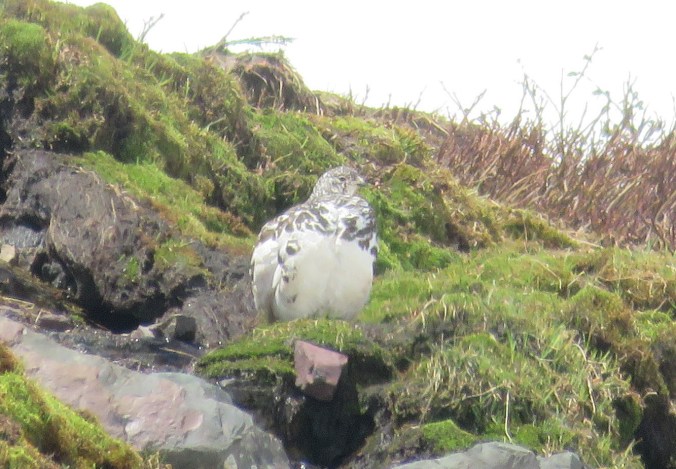
White-tailed Ptarmigan-1

White-tailed Ptarmigan (Lagopus leucura) Photo Credit: Theo Staengl

We watched the bird for a half-hour, and then headed back toward the road to get to Kalispell so we could get a good night’s sleep before our 5:30am flight home the next day.

Birding Highland County

One of the first field trips I took with the Blue Ridge Young Birders Club was in January 2014 to Highland County, looking for Golden Eagles, Rough-legged Hawks, and American Tree Sparrows.  Highland, a green, hilly county on the West Virginia border, contains a large wintering population of Golden Eagles.  I remember feeling a little intimidated by the older boys, who were so skilled at bird ID and so patient and generous with helping me see the birds.  My 7 year old brother was bored because he wasn’t that into birding yet, so he threw a snowball at the club’s Vice President.  Andrew responded with good humor and soon everyone was involved in a memorable snowball fight that helped me and my brother feel even more welcome.   We saw about 15 Bald Eagles that day.  At the time, they excited me almost as much as the single immature Golden Eagle we saw having a vicious air battle with a Bald Eagle.
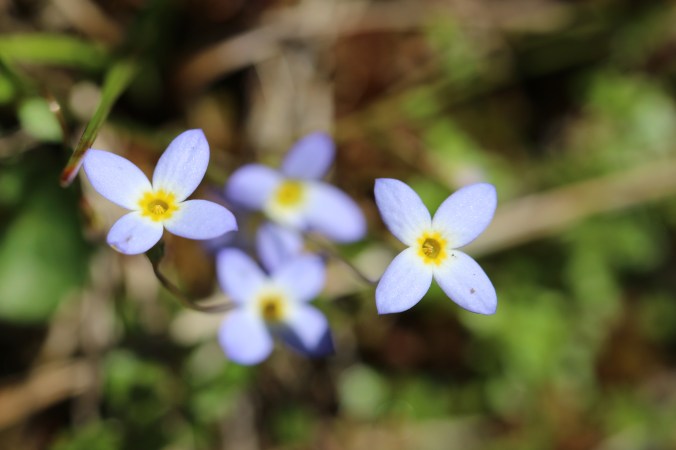
After having been to Highland for four winters in a row now, I desperately wanted to go in late May to see some of the breeding birds that are more common further north yet reach the southern limit of their range there.  Last year, I waited until June to go, and most of Highland’s rare breeding birds like the beautiful Golden-winged Warbler and Black-billed Cuckoo had already stopped singing.  This year, the date of the Blue Ridge Young Birders Club annual trip, May 21, finally worked for me.  As we descended into the Blue Grass Valley, we started seeing Bobolinks and Meadowlarks by the road.  This area of Highland is mostly endless farmland, so it can be a great place to look for field birds in the spring, and Golden Eagles in winter.  We made a few brief stops at little streams that flowed out of the lush, rolling green hills.  At one stop in the Forks of Water area, we found a Warbling Vireo, its boisterous, bubbly song intermingling with the sound of the swiftly flowing creek.  Other stops in the valley included a graveyard for Willow Flycatcher and a large cattle pasture for Vespers Sparrow (which we didn’t get, but we did have good views of a Savannah and Grasshopper Sparrow).

As we began to climb up toward the West Virginia border and Margaret O’Bryan’s house (the location of one of the best breeding colonies of Golden-winged Warblers in Virginia) the vegetation became more brushy, with young trees and shrubs instead of pasture.  I was most excited for this part of the trip, because Golden-winged Warblers were the only regularly occurring, eastern warbler that I hadn’t already seen.

Golden-winged Warblers are one of the rarest breeding warblers in Virginia.  According to the Cornell Lab of Ornithology, the Appalachian population has declined by 98 percent since the 1960s, to only 22,000 estimated breeding individuals in 2010, the steepest decline of any North American songbird.  These declines are most likely the result of the loss and degradation of the shrubby, early successional breeding habitat that Golden-winged warblers favor, as well as loss of wintering habitat in the tropics.  Another problem is that Golden-winged Warblers frequently interbreed with extremely closely related Blue-winged Warblers.  Scientists worry that the much more abundant Blue-winged Warbler could be swamping Golden-winged genetics.

Despite the recent steep decline, I am hopeful that we may still have breeding golden wings in Virginia 50 years from now.  For one thing, the Golden-winged Warbler Working Group and other conservation organizations have taken significant conservation actions, such as habitat restoration that could make a difference.  Also, new research by the Cornell Lab shows that hybridization probably shouldn’t be considered a threat to Golden-winged Warblers because they have been interbreeding with Blue-winged Warblers for most of their evolutionary history. In this view, the species distinction may be artificial, and the two “species” sharing genes may have helped them survive and adapt to changing conditions.

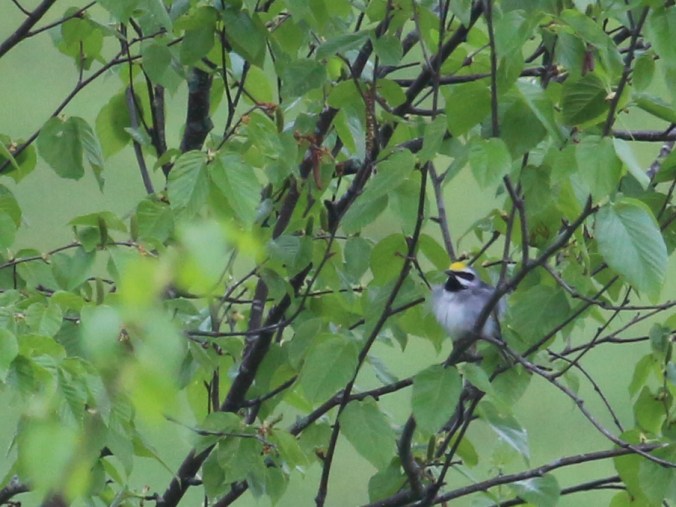
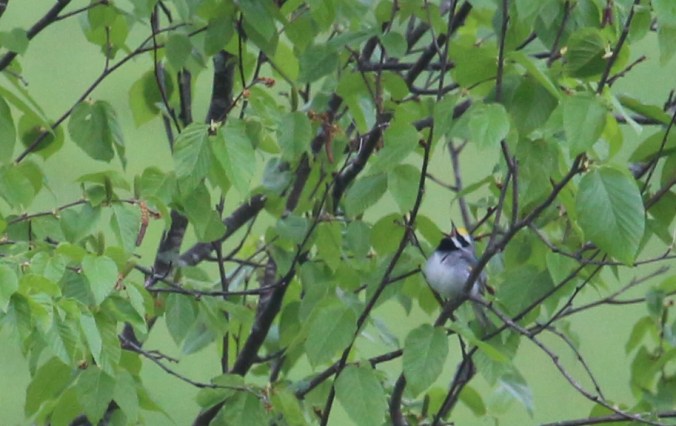
We parked by the edge of the road just short of the O’Bryan property.  As soon as everybody was out of the cars, as if on cue, the high, buzzy song of a Golden-winged Warbler came over the hill.  We all scrambled across the road trying to spot it from the tops of the dense, green foliage it likes.  As it sang again, Andrew (the same leader from that first Highland trip but soon off to college) spotted it in the top of a tree in the valley below.  It was a gorgeous, pure Golden-winged adult male, the fulfillment of a birding dream for me.

IMG_1550_edited-1

IMG_1540_edited-2

Golden-winged Warbler (Vermivora chrysoptera)

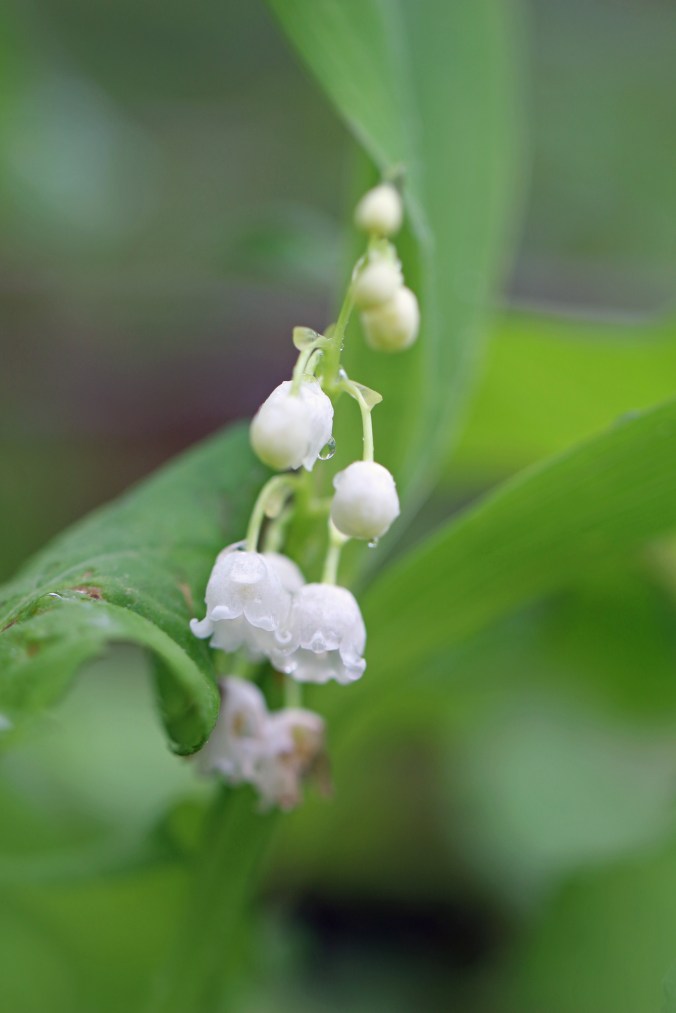
Thrilled with such early success, we continued up the mountain and over the West Virginia border, where we saw our second Golden-winged Warbler.  Two Golden-wings in two different states!  The next part of the trip took us into the George Washington National Forest along the VA/WV border, looking for warblers like Canada, Magnolia, and Blackburnian, all of which we eventually heard.  At one stop on a dirt road high in the mountains, I found American Lily-of-the-valley (Convallaria pseudomajalis), a life plant for me.

IMG_1573_edited-1.JPG

American Lily-of-the-valley (Convallaria pseudomajalis)

We descended into the Straight Fork area, where a complex of beaver ponds, creeks and open mountain meadows crossed the road.  This area is one of the best spots in Highland for Northern Odonates, which reach their southern range limit in Virginia and a very good site for Alder Flycatchers.  It wasn’t long before we heard the distinctive “free beers” song of Alder Flycatchers echoing around the stream.  Finding them wasn’t too difficult, but wasn’t that interesting, as they look almost exactly like Willow Flycatchers.  Still, it was nice to properly experience this uncommon breeder that I have never seen before.  The odes were not nearly as good as they could have been, possibly because of the cloudiness of the day, or maybe the time of year, with none of the really rare species and only some of the more interesting common northern ones present.

Our last stop was for Mourning Warblers at a fire road in the national forest.  Last June, two of them had aggressively responded to imitated chips here, and I was excited to try and repeat that.  We started walking down the fire road.  Suddenly Andrew tensed and told us to be quiet, indicating he had seen something.  He peered into the wall of greenery in front of us, and finally said he had a Black-billed Cuckoo.  We rushed forward and demanded he tell us where it was, validating Andrew’s caution in waiting to announce the bird before he’d ID’d it.  The Cuckoo, surprisingly tolerant, other than being in nearly impenetrable brush, let us get great looks and abysmal photos.  I have been fortunate enough to see a Black-billed Cuckoo in Virginia before, on migration, but for some in our party this was a Virginia lifer.  We never did see the Mourning Warblers, but what a great way to end a fantastic trip!

Difficult Creek Natural Area Preserve

A friend, Drew, and I started planning our trip to Halifax County’s Difficult Creek Natural Area Preserve in January. Difficult Creek is a former Pine savanna with hardpan soils, making it a very unique site in Virginia. Recently the Virginia Department of Conservation and Recreation (DCR) announced on Face Book their discovery there of a new colony of Tall Barbara’s Buttons, a southern piedmont endemic with only one other known extant site in the world and one of our main targets for the trip.

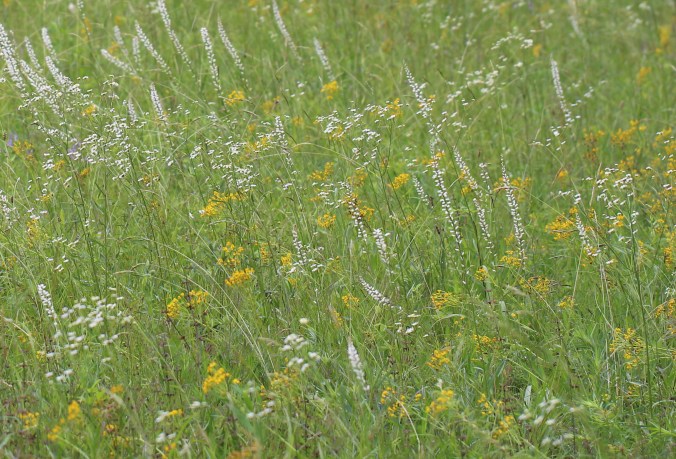
On our way down Route 15 just north of Farmville, Drew spotted a huge mass of white wands of flowers in a power cut. Excited at the thought of what they might be, we quickly stopped. Hundreds of White Colicroot (Aletris farinosa) grew in the power line cut along with Green Milkweed, Smalls Ragwort, Carolina Rose, and Sundrops.

IMG_1729_edited-1.JPG

White Colicroot is much rarer further north so we had never seen it before.

Shortly after entering the preserve on a windy road, we crossed Difficult Creek, its water muddy and torrential after all the recent rain. Southern Sugar Maple (Acer floridanum) and Winged Elm (Ulmus alata) grew in the forest around the creek. Soon we came to a large power line crossing the road. Underneath it bloomed the richest assortment of colorful wildflowers I had ever seen in a power line prairie. Carolina Thistle (Cirsium carolinianum), rare in Virginia, was one of the most abundant species. Plumed Thistle, Butterfly Weed, Dogbane, Green Milkweed, Green-and-Gold, Sundrops, Hyssop-leafed Skullcap, Mad-dog Skullcap, Pale spike Lobelia, and many asters, goldenrods, and other composites that were to young to identify were also plentiful.

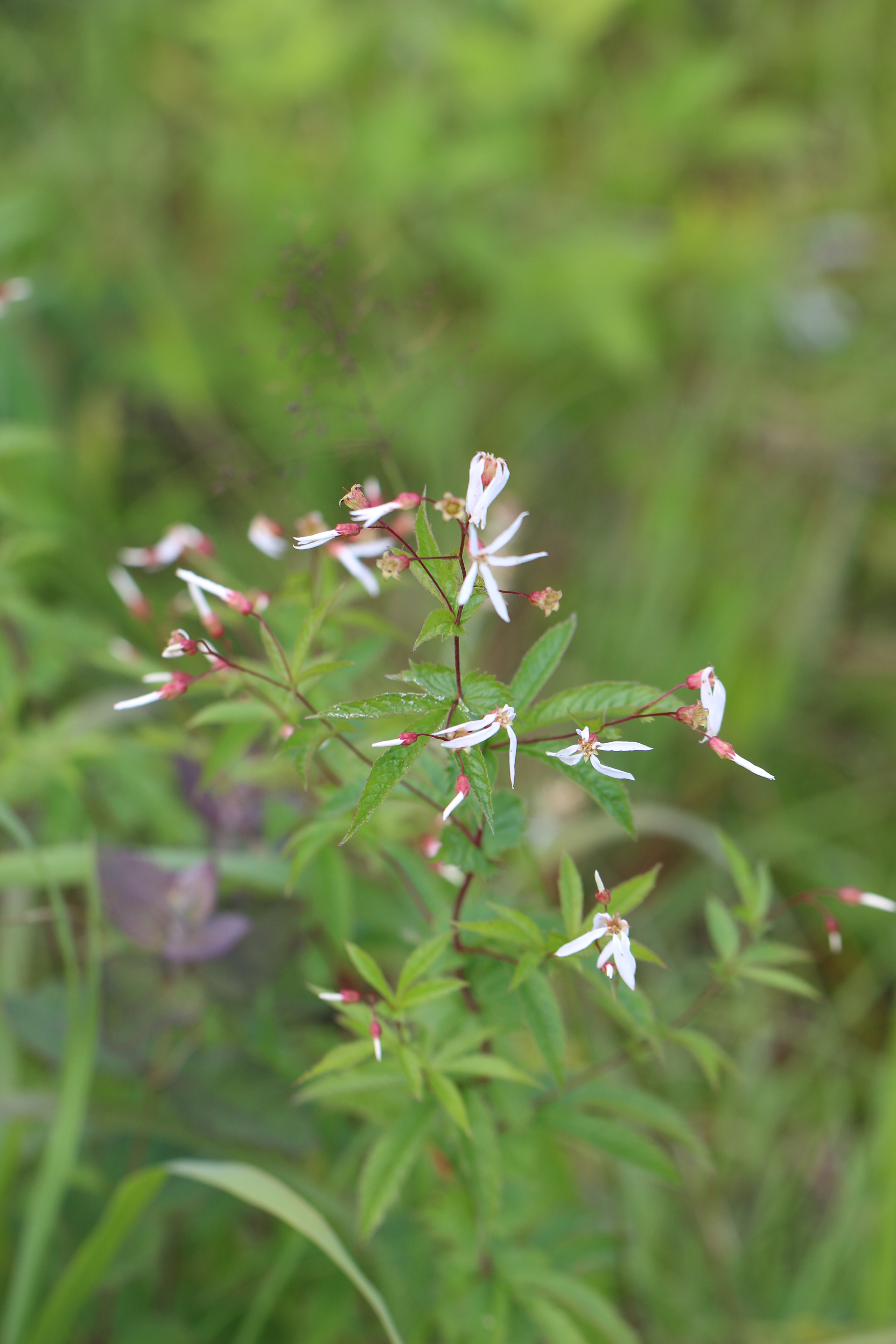
Soon, we also found White Milkweed (Asclepius albicans) and Carolina False Dandelion (Pyrrhopappus carolinianus), both life plants for me. As we explored the power cut, we kept finding southern piedmont specialties, plants that hardly ever occur elsewhere in the state. For example, American Ipecac (Gillenia stipulata) is listed by the Digital Atlas of the Virginia Flora to occur in Virginia only in Halifax and Wise Counties.

IMG_1795.JPG

American Ipecac

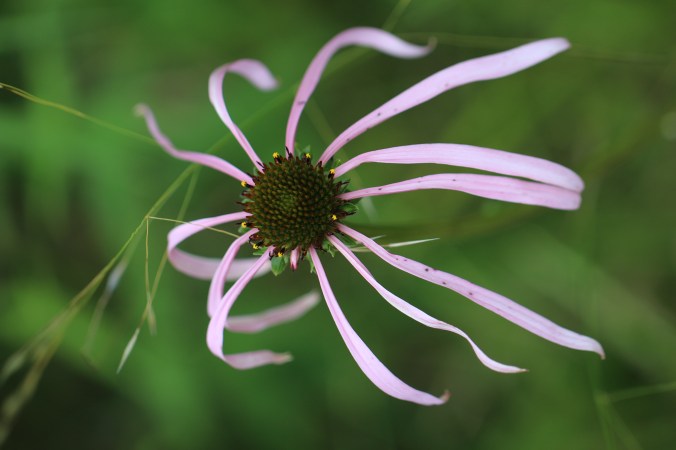
Other interesting plants we saw there were: Narrow-leaved Bluets (Houstonia tenuifolia), Old Field Milkvine (Matelea decipiens), Sampson Snakeroot (Orbexilum pedunculatum), Smooth Coneflower (Echinacea laevigata), and Lobed Coreopsis (Coreopsis auriculata).

IMG_1856.JPG

Smooth Coneflower

IMG_1825.JPG

Old Field Milkvine

The birds we saw and heard were species typical of southern piedmont pine lands, with the most common species being Summer Tanager, Prairie Warbler, Pine Warbler, Blue Grosbeak, and Brown-headed Nuthatch, always a treat to see away from the coast.  We also heard a Northern Bobwhite call a couple of times, only the second time I have ever encountered it.  Other notable birds were Yellow-breasted Chat and Hooded Warbler.

When we finished exploring the power line prairie, we accessed the preserve at another point, to keep looking for Barbara’s Buttons. Loblolly Pines grew above us, Willow Oak, Blackjack Oak, Post Oak, and Sourwood made a dense shrub layer. The herbaceous diversity was not nearly as high as it had been in the open power line corridor.

As we were finishing our lunch, heavy clouds came in and it started to pour.  We quickly ran back to the car to finish eating, complaining about how difficult the rain would make photography, and how generally unpleasant it was.  Right when we were about to go out again, a DCR truck pulled up and its driver asked if we were looking for wildflowers.  We said we were, and asked him if he could show us the site for Tall Barbara’s Buttons.  It turned out the driver was Chris Ludwig, Chief biologist of the Virginia Department of Conservation and Recreation’s Division of Natural Heritage.  He showed us a small colony of Tall Barbara’s Buttons (Marshallia legrandii), which, despite the still heavy rain, we photographed profusely.

IMG_1873_edited-1.JPG

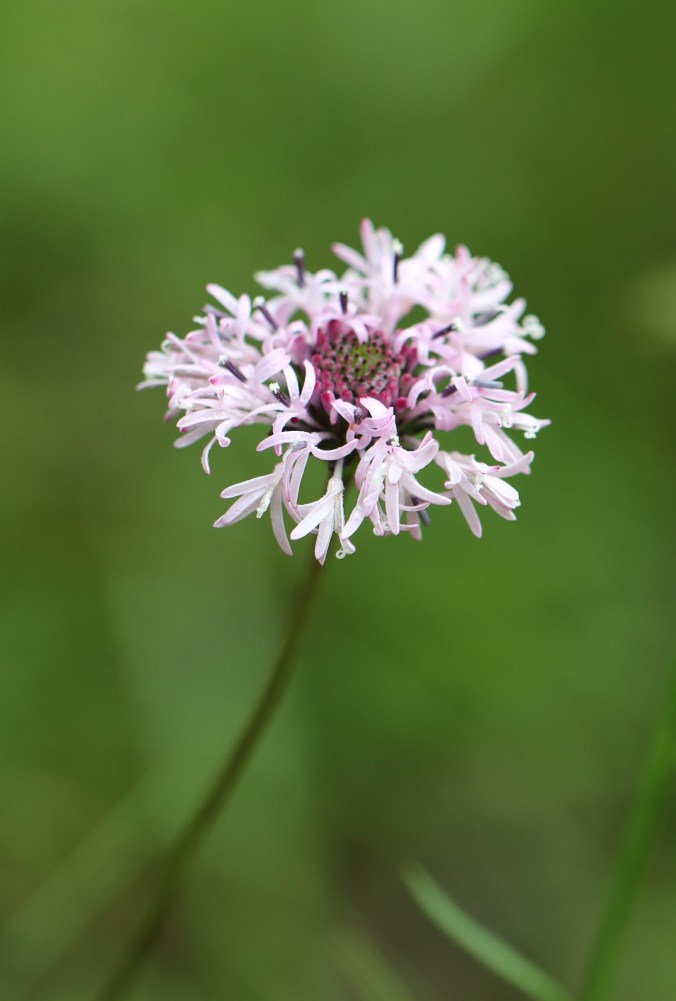
Tall Barbara’s Buttons

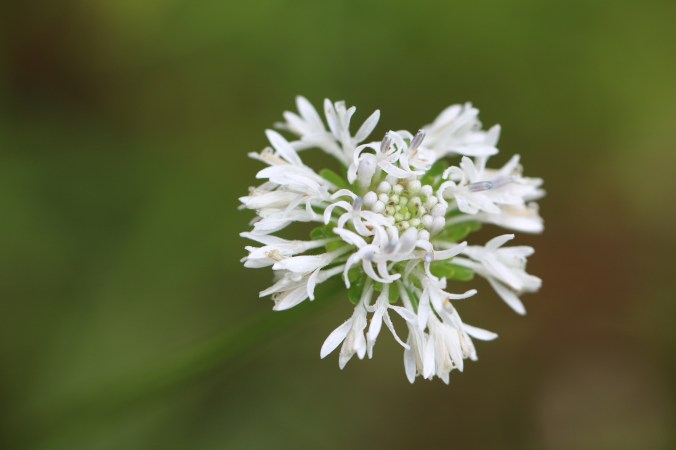
The pouring rain necessitated that we keep moving if we did not want to get soaked, so we asked Chris if he would show us a colony of the much more common (but still new to us) Piedmont Barbara’s Buttons (Marshallia obovata), which also grows at the preserve. He took us to a large colony, and I was surprised at how different the two Barbara’s Buttons were from each other. I had been prepared to measure the height of the stalk in order to tell one from the other, but found that Tall Barbara’s Buttons had deep pink flowers and Piedmont Barbara’s Buttons had pure white flowers.  I am sure flower color in these species is somewhat variable, and I am very curious as to the color of Tall Barbara’s Buttons at the other site it is known from in North Carolina, and to the color of other colonies of Piedmont Barbara’s Buttons.

IMG_1896.JPG

Piedmont Barbara’s Buttons

Chris then showed us the few other plants we had missed on our first exploration of the power cut, such as Rattlesnake Master, and Glade Wild Quinine (we had seen Common Wild Quinine earlier, so we were able to compare the species). He also identified the strange sheep like sound of an amphibian we had been hearing all day as a Eastern Narrow-mouthed Toad (Gastrophryne carolinensis).


Chris also told us how DCR was managing Difficult Creek.  About 40 years ago, the preserve had been converted to a Loblolly Pine plantation from hardwood forest.  As the Pines grew, they forced the herbaceous flora into the adjacent power line clearing that we had just explored. The power line cut was mowed every couple of years, which kept woody plants from encroaching and cutting off light.  DCR’s plan is to restore the preserve to pine savanna, an open canopy of pines, oaks, and hickories maintained by fire, that would have historically occurred throughout the southern piedmont before the colonial period.  They hope to accomplish this by prescribed burns and Loblolly Pine removal, which would let more light reach the ground, allowing the plants to recolonize the preserve from the power line clearing.  In addition to this restoration regime providing fantastic habitat for so many rare southern piedmont plants, it would create ideal habitat for Northern Bobwhites.

We were thrilled by the success of our trip, and the thought of that rich power cut prairie spreading throughout the entire preserve.


The Biggest Week in American Birding 2017

Last year at the Biggest Week in American Birding in Northwest Ohio, I remember seeing warblers everywhere I looked from the Magee Marsh Wildlife Area boardwalk.  By the end of the festival, we had seen 31 species of warblers, including rarities such as Kirtland’s and Mourning Warblers.   Other migrants were also abundant: Whippoorwill, Black-billed Cuckoo, Curlew Sandpiper, Wilson’s Phalarope, and White-rumped Sandpiper to name a few.  Magee Marsh and other wildlife areas that line Lake Erie in that area serve as migrant traps, where many birds stop to rest and refuel before crossing the lake.  I was very excited to be going back.

As we drove to the festival, though, I started worrying.  Migration was late this year and we had to get back to Virginia to attend the Mount Rogers Naturalist Rally.  These plans meant that we couldn’t stay till the end of the week when the rarer warblers and flycatchers would be expected even under more typical migration timing.

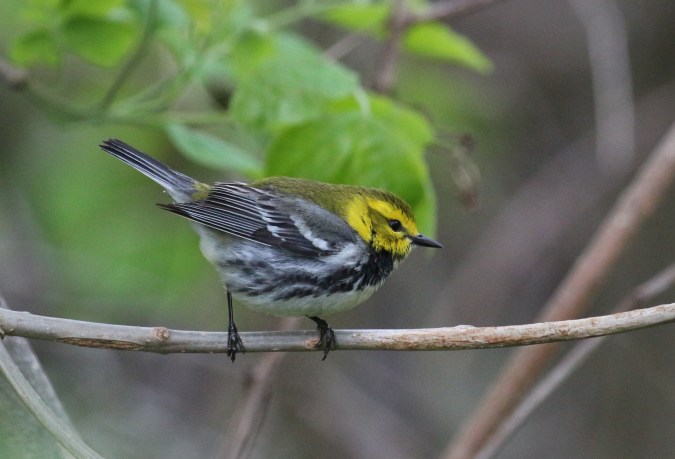
Our first morning, we started early at Magee Marsh.  Unfortunately, compared to last year, the boardwalk was dead.  It seemed like there were more warblers back in Virginia.  We found 41 species of birds that morning and I was able to photograph this posing Black-throated Green Warbler.

IMG_1189_edited-1.JPG

Black-throated Green Warbler

Feeling a little depressed at having birded the self proclaimed “Warbler Capital of the World” for an hour yet seeing only 6 warbler species, we headed to the nearby Metzger Marsh Wildlife Area.  As we pulled into the small, empty parking lot, we saw 4 Sandhill Cranes fly overhead, their strange rattling calls filling the sky.  We found a muddy trail on a narrow stretch of ground just barely elevated above the water on either side of it, leading off into the wide open marshlands.  As we walked onto this little dike, we heard several Sora.  We saw American Coots and Common Gallinules in the open sections of water.  Suddenly, something sprang into flight from some grass next to my brother’s feet.  As it flew, I registered the small size, little trailing feet, and tannish coloration of a Least Bittern.  It landed at the top of some marsh grass, and we had a few seconds to look at it before it slid down the stalk and disappeared.  This Least Bittern was only the third one I had ever seen.  Marsh Wrens sang along the trail, but sadly we were never able to see one.  Not bad marsh birding at all: Sora, Common Gallinule, Marsh Wren, Sandhill Cranes, and Least Bittern!

We returned to the car and checked the Biggest Week twitter feed.  Someone had reported two Upland Sandpipers, a lifer for me, at Grimm Prairie at the Ottawa National Wildlife Refuge.  When we got there, we saw a line of birders with scopes standing in the parking lot staring into the empty field.  The birds hadn’t been seen for awhile and were probably behind a clump of grass.  We got our scope and scanned the field, but the heat haze was so thick that we couldn’t see much in the distance.  Deciding that we would bird the rest of Ottawa and keep our eyes on twitter in case the birds were re-found, we packed up and left.

Hundreds of swallows of 5 different species surrounded us as we started down the foot trail around the impoundments at Ottawa.  I saw a Bank Swallow among the much more prevalent Tree, Northern Rough Winged, and Barn Swallows and Purple Martins, but my brother, who had never seen one, missed it.  I was therefore distracted the rest of the afternoon by the necessity of scanning every swallow that came by to try to find another Bank for him.   We didn’t see another one.  Nevertheless, I did enjoy seeing Black Tern, Least Flycatcher and a Black-crowned Night Heron there.

Back at Grimm Prairie, we saw the Upland Sandpipers (if you can call the horrible, distant, distorted scope views we had ‘seeing’) although certainly not as well as I would have liked through the heat haze.

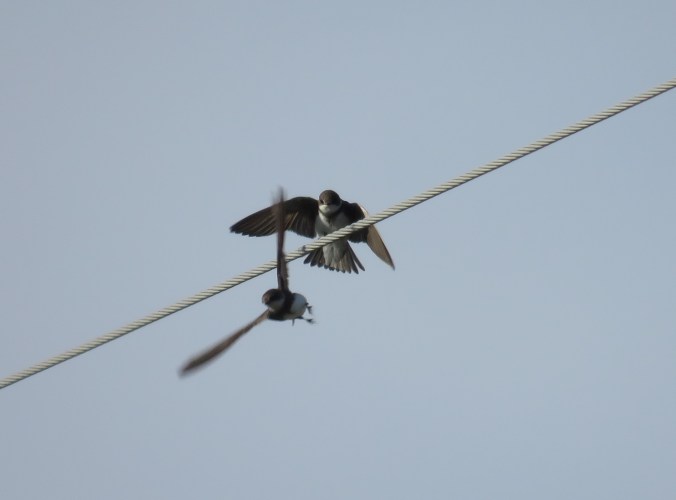
The next morning, we started by stopping at the intersection of Angola and Raab Roads, which had a Curlew Sandpiper last year.  This year we had 5 swallow species including Bank and Cliff on the wire by the road.  My brother was very happy about finally finding a Bank.

IMG_4272_edited-1.JPG

Bank Swallows by Theo Staengl

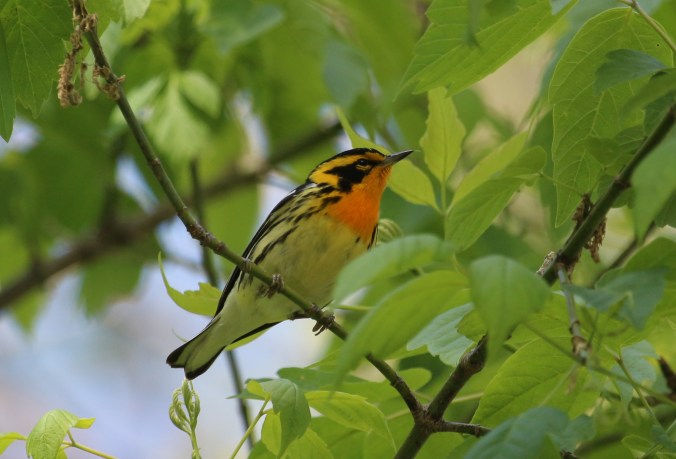
We spent the rest of the morning birding the metro parks of Toledo.  At Oak Openings Metropark, we got Lark Sparrow, Red-headed Woodpecker, Least Flycatcher and Nashville Warbler.  At Pearson Metropark we saw almost nothing.  Later in the afternoon, we headed back to Magee to see if anything new had shown up.  There was more Warbler activity, with Blackburnian Warbler, Northern Waterthrush, Orange Crowned Warbler, and Cape May Warbler, but it still didn’t compare to last year.

IMG_1068_edited-1.JPG

Blackburnian warbler

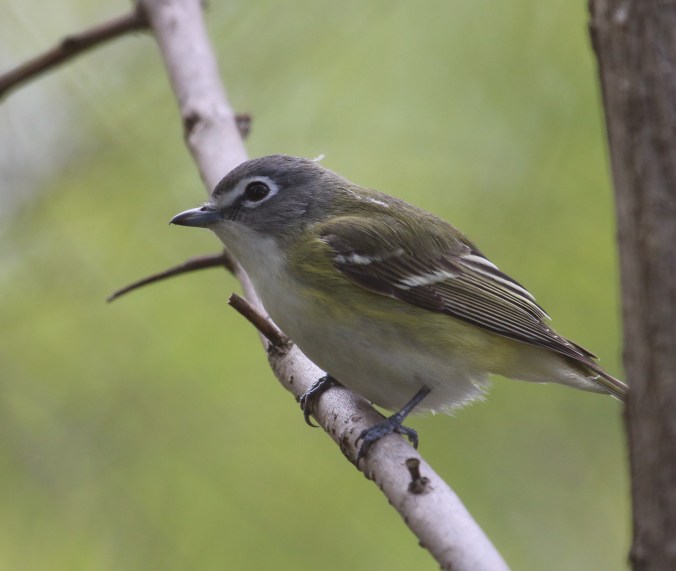
The next day (Wednesday), things were finally really starting to get better as far as migrant passerines were concerned.  We had 60 species of birds on the Magee Marsh boardwalk, with 19 species of warblers.  Prothonotary, Blue-winged and Hooded were some of the better ones we saw.

IMG_1031_edited-1.JPG

Blue-headed Vireo

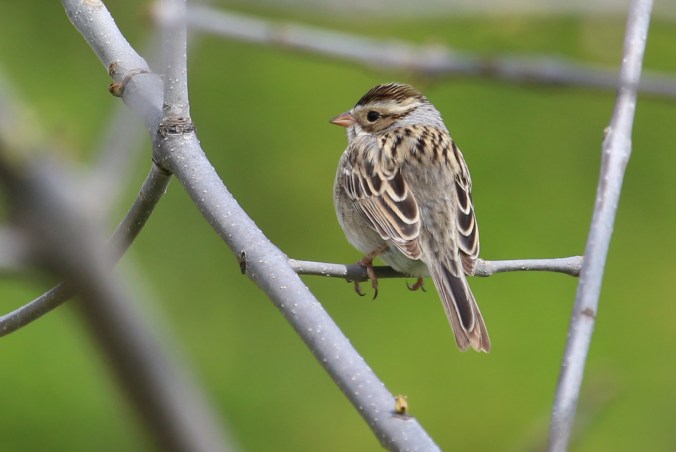
That afternoon, we went to Maumee Bay State Park, where birders had spotted a Clay-colored Sparrow.  As we waited for it to stick its head out of the grass, we watched Purple Martins gracefully wheeling overhead and landing on the artificial gourds that had been set out for them.  Just as we were getting ready to bird the Maumee boardwalk and come back for the Sparrow later, it flew out of the grass, circled its crowd of gathered admirers and landed in a leafless tree right in front of us.  It was the second time I have seen a Clay-colored Sparrow, but this time provided, by far, the better looks and photos.

IMG_1259.JPG

Clay-Colored Sparrow

We spent the  rest of the day slowly birding the Maumee boardwalk, enjoying the peaceful swamp forests.  Veerys seemed to hop on every other fallen log.  We  saw the well-known red morph Eastern Screech Owl that reliably roosts in a box next to the trail.  Ovenbirds, Nashville Warblers, and Yellow Warblers sang in the willows and cottonwoods.

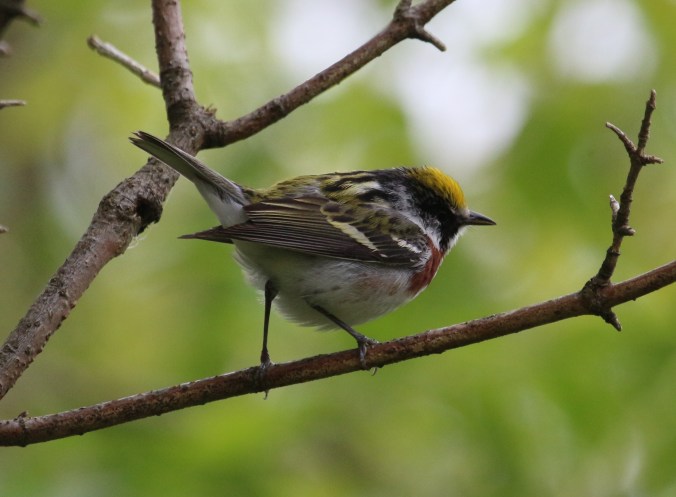
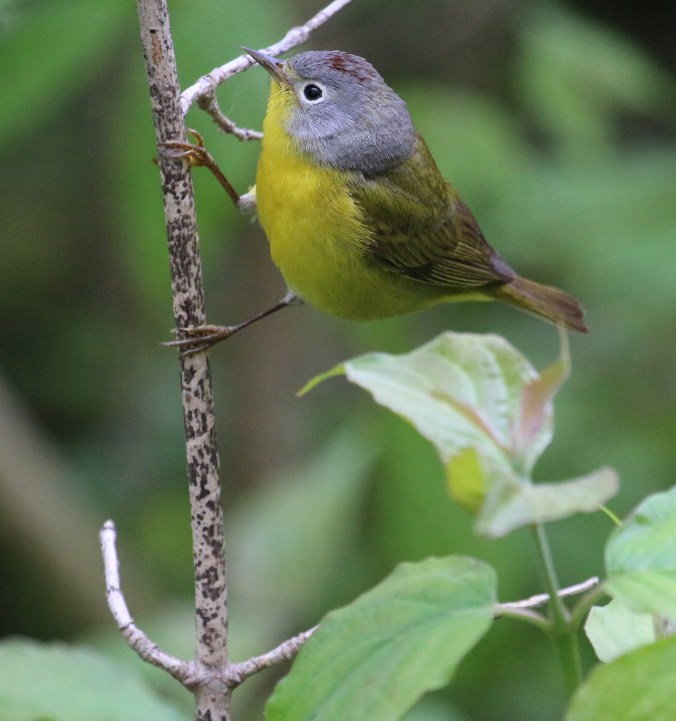
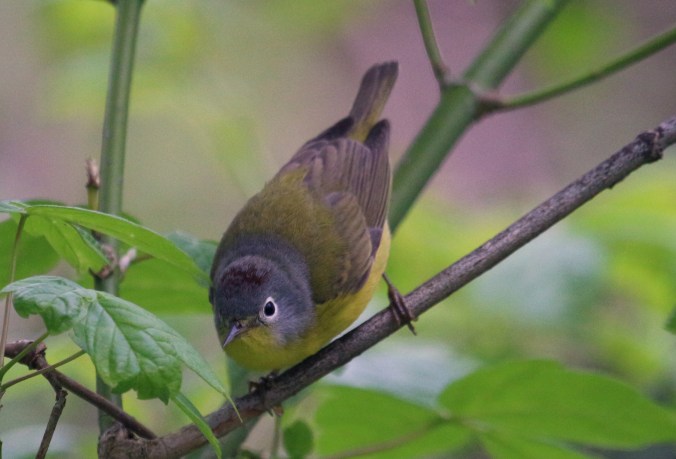
We had to leave for Virginia by 10am Thursday morning, so we didn’t have much time to bird.  We decided to bird Magee Marsh for the whole time in hopes that migration would have picked up.  It was the best day so far, and at times it was almost as good as it had been last year.  One of the best things about Magee Marsh, second to the bird themselves, is that you can see warblers only feet from you at the edge of the boardwalk.  And even when they are not posing perfectly, they are never very high in the canopy like they are back home.  The birds’ proximity and diversity make this an exceptionally good location for warbler photography.  Here are some favorite photos that I took that last morning in Ohio:

IMG_1218_edited-1.JPG

Chestnut-sided Warbler

IMG_1235_edited-1.JPG

Nashville Warbler

IMG_1250_edited-1.JPG

Nashville Warbler

We also got great looks at Bay-breasted Warbler that day, and so many other warblers.  By the end of the trip, our trip list was 130 species, and we had seen 22 species of warblers.  Not as good as last year, but we had a lot of fun, and saw plenty of birds.

Mount Rogers Naturalist Rally Part 2: Sullivan Swamp at Grayson Highlands

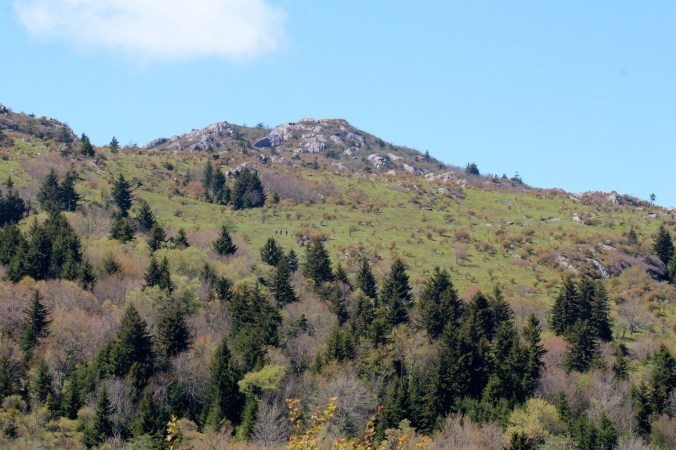
From the parking lot, we looked out on the windblown landscape of Grayson Highlands State Park.  We saw huge rock outcrops surrounded by beautiful meadows and balds.  On the hill directly in front of us, scattered Red Spruce and Highbush Blueberry grew, fading into the mountains behind them.

IMG_1413_edited-1.JPG

View of Grayson Highlands

All around us, breeding birds with northern affinities sang, Black-Throated Green Warbler, Chestnut Sided Warbler, Dark eyed Junco, and Black-capped Chickadee.  We were here to visit Sullivan Swamp, one of only thirty known Appalachian Shrub Bogs in the world.  Upon entering the small valley of Sullivan Swamp, my feet started to sink into the marshy ground.  Huge, furry fronds of Cinnamon Fern, just beginning to unfurl, grew on the tufts of earth that rose a few inches above the surface of the bog.  We walked through thick matts of green and red Sphagnum moss, trying not to think about all the plants we were stepping on.  Marsh Blue Violet (Viola cucullata) and Northern White Violet (Viola macloskeyi)  grew everywhere in the sphagnum mat.  I photographed a patch of Thymeleaf Bluet (a different species than the bluet common in the piedmont, (Houstonia cerulea)) growing on some rocks.

IMG_1384.JPG

Thyme leaf Bluet (Houstonia serpyllifolia)

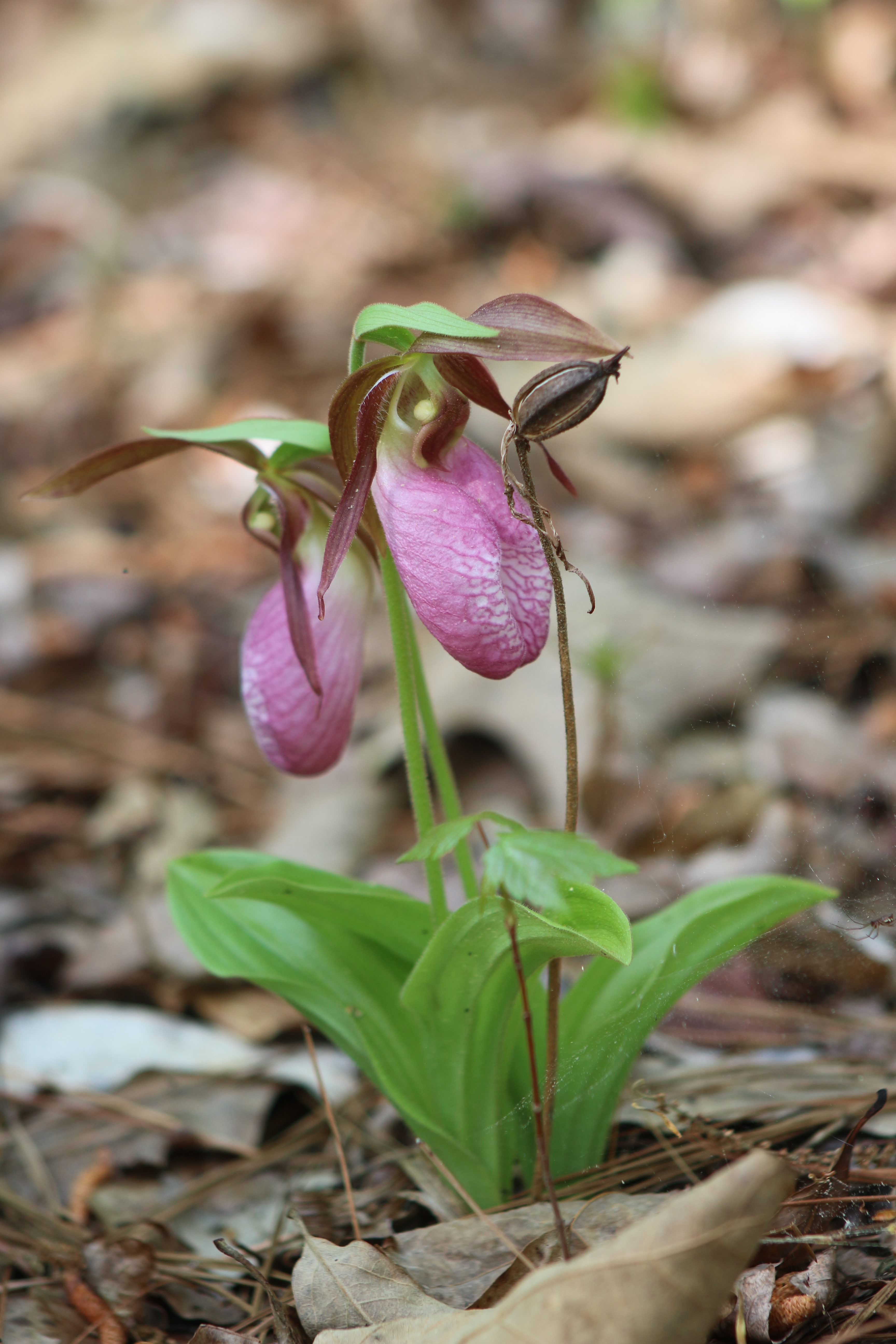
The weather was gray and rainy, perhaps the reason none of Sullivan Swamp’s famous butterflies were out, but we did find a new species of plant for the location, Pink Lady Slipper.

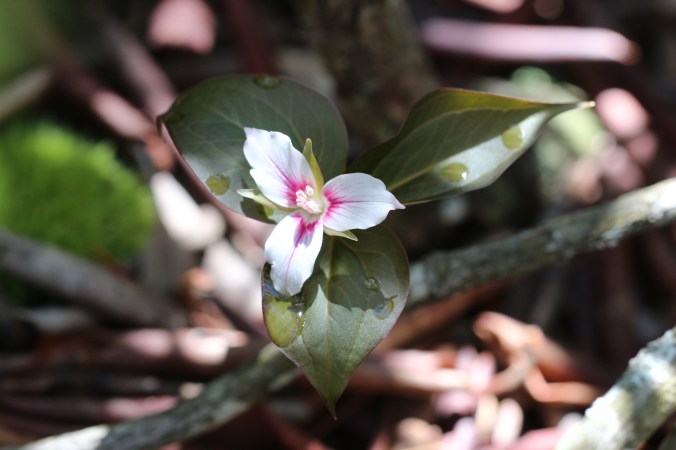
Growing on the higher, drier ground off to one side of the bog, underneath a thick layer of Rhododendron, were a few Painted Trillium (Trillium undulatum).

IMG_1393.JPG

Painted Trillium (Trillium undulatum)

It was a beautiful place with rare and interesting plants, but I think that later in the summer when more things are blooming and more butterflies and Odonates are flying would be a better time to visit this fantastic ecosystem.

See the Blue Ridge Discovery Center blog here and here for more information on Sullivan Swamp.


Piney Grove and the Dismal Swamp

Piney Grove Preserve is the only place in Virginia where the endangered Red-cockaded Woodpecker lives. It is also the furthest north site for this species.  As we drove down the narrow entrance road to the preserve, we could hear the rising song of Prairie Warblers from almost every clump of vegetation by the road.  Eastern Towhees, Black-and-white Warbler, and Ovenbirds also sang along the road.  Old Loblolly and Long-leaf Pines towered over the understory of Wax Myrtle and young Black and Water Oaks, creating the beautiful habitat of southern pine savannah. We photographed several Pink Lady’s Slippers that grew in the thick mat of decaying pine needles covering the forest floor at the entrance to the Nature Conservancy’s Darden Nature Trail.

IMG_0332.JPG

Pink Lady’s slipper (Cypripedium acaule)

IMG_0343_edited-1.JPG

Very pale Pink Lady’s Slipper

I saw a couple of Brown-headed Nuthatches foraging in the smaller pines.  This small species only lives on the Coast, so I don’t get to see them very often.  Theo, my brother, brought my attention to a very distant, slow, “yank yank yank” call, clearly a Red-breasted Nuthatch.  Soon after, I heard the faster, jerkier call of the White-breasted Nuthatch.  It was the first time I had ever seen all three eastern Nuthatches in the same day!  We saw Ovenbirds and Yellow-throated Vireos, but no Red-cockaded Woodpeckers.  We decided to drive the main road of the preserve to look for the spot we had seen them the last time we came here, over a year ago.  As we were pulling out of the parking lot, Theo spotted a Blue Grosbeak sitting on a tree beside the road.  What an unexpected treat! They are a common breeder in this habitat later in the year, but this was the first one I had seen this season.   We walked down the main road, seeing plenty of Pine Warblers, Prairie Warblers, Palm Warblers, Common Yellowthroats, and Yellow-throated Warblers, but still no Red-cockaded Woodpeckers.  Suddenly, two “footballs with wings” exploded out of the brush in front of us, their feathers making a tremendous noise.  Bobwhite! This was a very long awaited lifer. After lunch we decided we’d better head to the Dismal Swamp if we wanted to have much time there, so with much regret, we gave up on the Red-cockaded Woodpecker and got into the car for the drive.

Our first stop at the Great Dismal Swamp NWR was Jericho Ditch, a famous spot for the elusive Swainson’s Warbler.  When we got out of our car, the sight that greeted us was not exactly spectacular.  A long path stretched into the hazy distance with a ditch nearly hidden by dense, shrubby vegetation beside it.  Heat shimmered off the gravel parking lot.  We heard and then saw several Prothonotary Warblers, their brilliant yellow bodies contrasting with their slate grey wings.  As we walked along the ditch, giant Swamp Darners and other dragonflies swarmed all about us.  Eventually, we heard a Swainson’s Warbler sing about 10 feet off the trail.  We stood and waited patiently, tried “pishing,” and even tried to enter the dense brush and briers that made a wall at the edge of the trail, but nothing we did let us see the bird.  After we waited for a good half hour, we gave up seeing it and went to Washington Ditch.  Washington Ditch was much nicer than Jericho Ditch, with real coastal swamp forest instead of scrub.  Mature Red Maples, Willow Oaks, and Water Oaks cast a cooling shade, with lush Devils Walking Stick and Cinnamon Fern carpeting the forest floor.  As we walked along the wide cool path, we heard the noises of a mixed flock off to the left.  Soon Yellow-rumped and Prothonotary Warblers sang on either side of us.  Then we heard the distinctive “whee whee whee whip-poor-will” song of a Swainson’s Warbler.  I found the bird this time, due to the more open canopy, and enjoyed my first views of it.

IMG_0372_edited-1.JPG

Swainson’s Warbler

After the Warblers had moved on and we were walking back to the car, we heard a Barred Owl call through the distant swamp woods.

Briery Branch Gap

I finally made it up to Briery Branch Gap, on the Virginia-West Virginia border, again.  It’s the only place in Virginia where Red Crossbills are seen regularly.   The last time I came up here, in March, we didn’t see any Crossbills, even though large flocks of them had been seen recently.  Snow covered the ground that day, but the air was warm enough (about 50 degrees), so we figured we’d be fine.  As we started up the trail, a group of huge, noisy, monster trucks came roaring through the six inches of muddy slush and snow carpeting the narrow dirt road.  Well, so much for being dry, but the sun was still shining and it was still warm (relatively), so we kept walking.  As we got up to the campground where the Crossbills usually are, a dark, ominous, storm cloud started to roll in from West Virginia.  The temperature dropped noticeably, and it started to drizzle.  I did my best to ignore these signs, despite faintly remembered warnings about rapidly changing mountain weather.  The further we hiked, the colder it became.  We navigated around huge pockets of mud colored slush covering deep pools of frigid water.  My foot slipped into one of these pot holes.  It started to rain — cold, hard, persistent rain, soaking our long sleeve shirts and threatening to ruin our cameras.  We turned and ran for the car, which was, unfortunately, at least half a mile away.  Both of my feet were numb.  I couldn’t feel them as I ran clumsily down the mountain.  Right as we got to the car, the rain stopped and the sun came out.  The temperature rose twenty degrees and the snow started visibly melting.  I had a hard time believing that just a few minutes ago, we were in the middle of a winter storm.  Looking down at the thick blanket of dark clouds in the valley far below us, though, I could see where the storm had gone.  Needless to say, no Crossbills that day, but I did enjoy seeing interesting high-elevation plants, such as Mountain Fetterbush and Red Spruce, and strange, introduced, exotics, such as Red Pine and Norwegian Spruce.
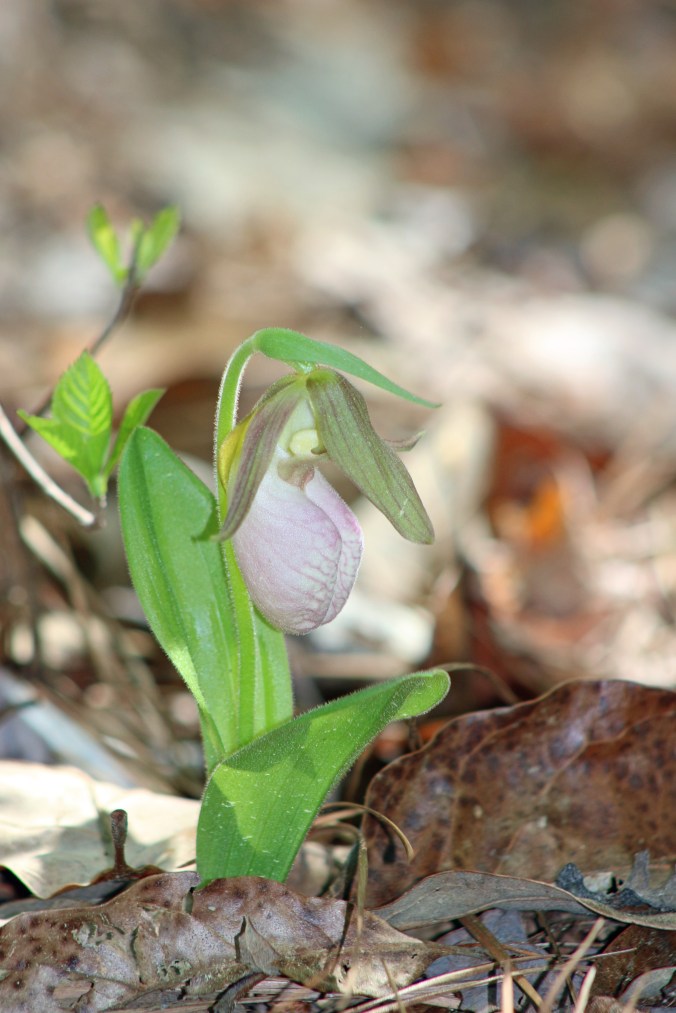
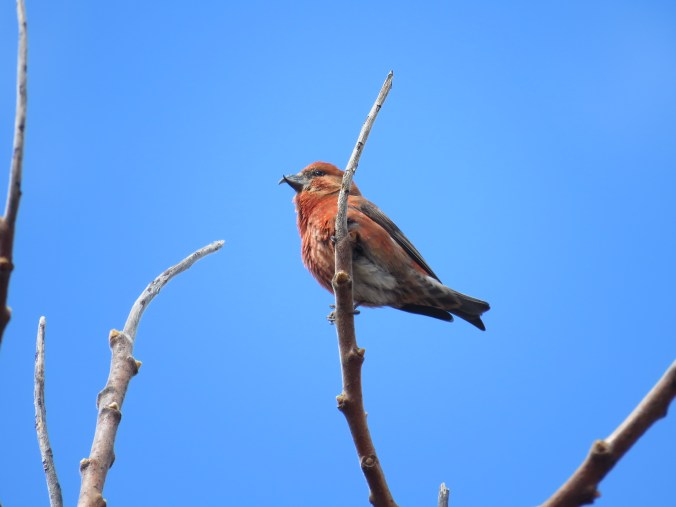
 

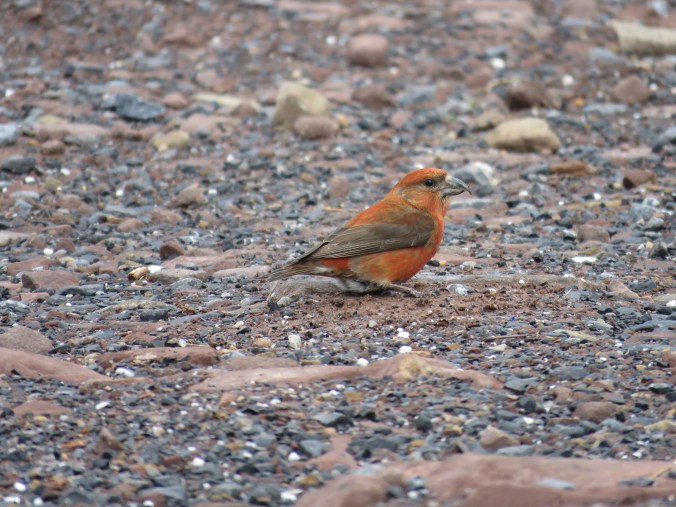
This time, in April, the snow was all gone.  We got out of the car and ate lunch.  As we were finishing, we heard the distinctive flight call of a Red Crossbill in a large Chestnut Oak just on the other side of the hill.  I tried to find the bird, but ended up walking in a big circle.  Fortunately, my brother spotted a male sitting on top of a little clump of sumac a few feet from us.  It stayed still and let us photograph it for awhile, before flying onto the road right in front of us, to peck at the gravel.   Crossbills are very approachable when they “gravel,” and this one was no exception, as I was able to get within ten feet of it.

IMG_8195.JPG

IMG_8248.JPG

Photo credit: Theo Staengl

After the Crossbill flew away, we had a nice, thankfully rain free hike (not that we were so unprepared this time!), up the road for a couple of miles.  We saw the usual high elevation species, like Red-breasted Nuthatch, Black-capped Chickadee, and Common Raven.  There were also many Fox and Chipping sparrows.  When we got back to the car, we heard two Blue-headed Vireos singing.  We quickly found these beautiful birds and enjoyed looking at them until we had to go.

Two Orioles and Two Owls

When I heard there was a Black Backed Oriole in Pennsylvania, I hoped we could make the trip since it would be such a great chance to see this rare species.   It’s a non-migratory species endemic to Mexico, so what was it doing in PA?   We went to the Black Backed Oriole, nicknamed “BB,” stakeout first, in hopes of getting our main target out of the way so we could relax and enjoy the rest of our trip. When we got to the right neighborhood, we saw two birders with a scope standing on the sidewalk looking across the street at a feeder. They hadn’t seen the bird yet so we stood with them and waited. After about twenty minutes “BB” came to the feeder briefly and sat in a cedar tree, where the dense evergreen branches mostly blocked it from view.

20170310_143717.jpg

We wanted better photos so we stayed, hoping that it would come to the feeder again. The owner of the house, Tom, came out to chat with us. He was the perfect example of what I wish all property owners near a rare bird would be like. He enjoyed all the attention and was interested in birds and birders.  He’s even made a face book page about “BB!”   He seemed to think of his role as the birder watcher. He told us to sign into the little booklet that he had because he was sending it to someone in Australia who was doing a study about the economic impact of birding.   Apparently people from thirty states, some Canadian provinces, and a couple of European countries have come to see this bird! Imagine how that might help a region’s economy! This is especially ironic because “BB” is probably not really an ABA countable, wild vagrant from Mexico, but rather an escaped cage bird.   So basically, someone could just let a super rarity out of a cage and many birders will come to see it and spend money on hotels, meals, etc.  Sadly, “BB” did not come back to the feeder for another hour, so we moved on, thinking that we would try to get better pictures in the morning before we left.

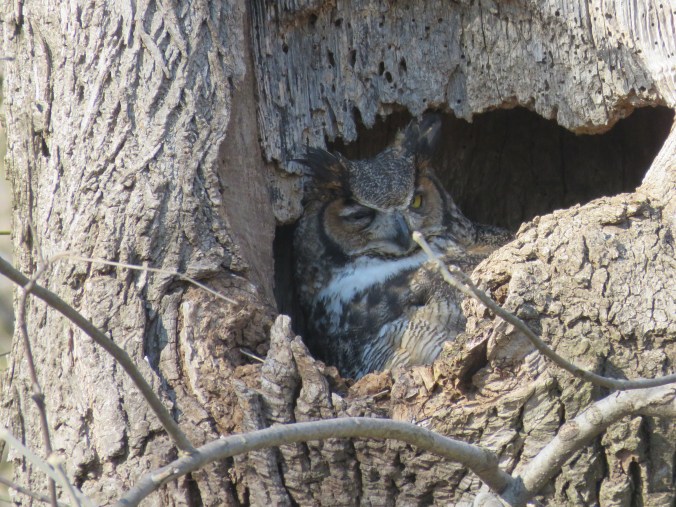
Our next stop was a nearby park with a Great Horned Owl nest that one of the birders visiting “BB” had told us about.  We found the large bird easily, sleeping inside a hole near the parking lot.

IMG_5063.jpg

Photo credit: Theo Staengl

We finished the day at Middle Creek Wildlife Management Area, which has been getting some good birds lately, like Eurasian Widgeon and Golden Eagle. The highlight for us, though, was the large number (over 1000) of Tundra Swans on the lake.  I hope everyone has the chance to experience huge flocks of any water bird making noise. Thousands of Sandhill Cranes, thousands of Snow Geese, or thousands of wintering swans make a truly gorgeous noise.  The Tundra Swans filled the space around us as they flew overhead and landed on the lake, constantly calling long, rattling, trumpeting noises that blended together to create one musical chorus.  To see or hear birds, or most wildlife, really, in such abundance is always special.

As dusk fell, a lone short-eared owl put on a show for us hunting over the fields in the waning light.

The next morning, it was snowing heavily and much colder. Our first target was a Bullock’s Oriole, a western species rarely seen east of the Mississippi.  We sat in our car and waited as we watched the Flickers and Juncos, among other birds, coming to the feeders.   Soon, the Bullock’s landed on the suet feeder.  It was an immature male, shining brightly against the dreary wet snow, with a bright yellow breast and black throat spot and eye line.

IMG_5527.jpg

Photo credit: Theo Staengl

Next we went back to Middle Creek WMA. This time, in addition to the large numbers of Tundra Swans, Black Ducks, Shovelers, and Canada Geese, there were also 12 Common Mergansers and thousands of Snow Geese on the main lake. The driving snow made it very difficult to scan the large body of water for more waterfowl, so we decided to drive around a little wildlife loop in hopes that the storm would stop. We quickly found three American Tree Sparrows in a flock of sparrows foraging on the roadside (the only not snow covered ground).  Even though Tree Sparrows are fairly common in Pennsylvania, we were excited to see them, as we rarely see them in Virginia.

IMG_9491_edited-1.JPG

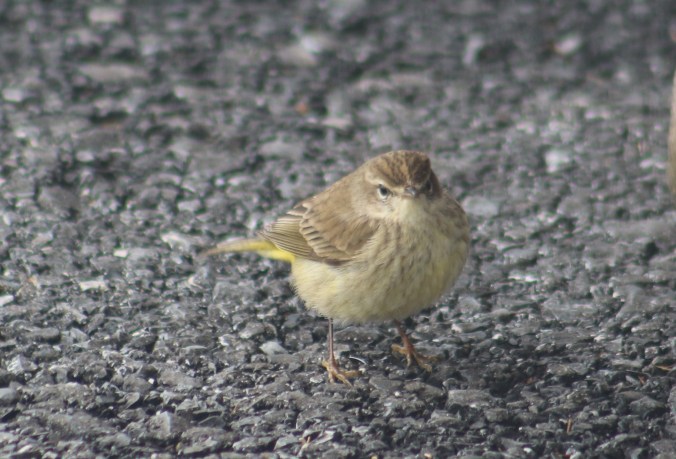
Other notable sightings on the wildlife loop were Killdeer, Wilson’s Snipe and Horned Larks. As the storm blew out, we drove back to the trail to the lake. The Tree Sparrows still foraged in the bushes by the road. A mixed flock descended out of the trees, both Carolina and Black-capped Chickadees calling and flying around everywhere. We flushed a small flock of Rusty Blackbirds, a year bird for me! At the lake, we saw some Green Winged Teal and three Ruddy Ducks.  Huge flocks of snow geese flew overhead, with both blue and white morph birds. My brother spotted a Palm Warbler hopping around in the snow. This crazy bird should have been in the deep south now, so this was quite a surprise! Palm Warblers have such a distinctive habit of pumping their tail up and down constantly that it is used as a field mark.

IMG_9551_edited-1.JPG

When I totaled up my Pennsylvania life list I found it had 96 species. I do not know about you, but I really hate seeing numbers that are so close to a good solid 100 but not quite! Overall, we had an amazing trip and I am very glad to be back home now.